

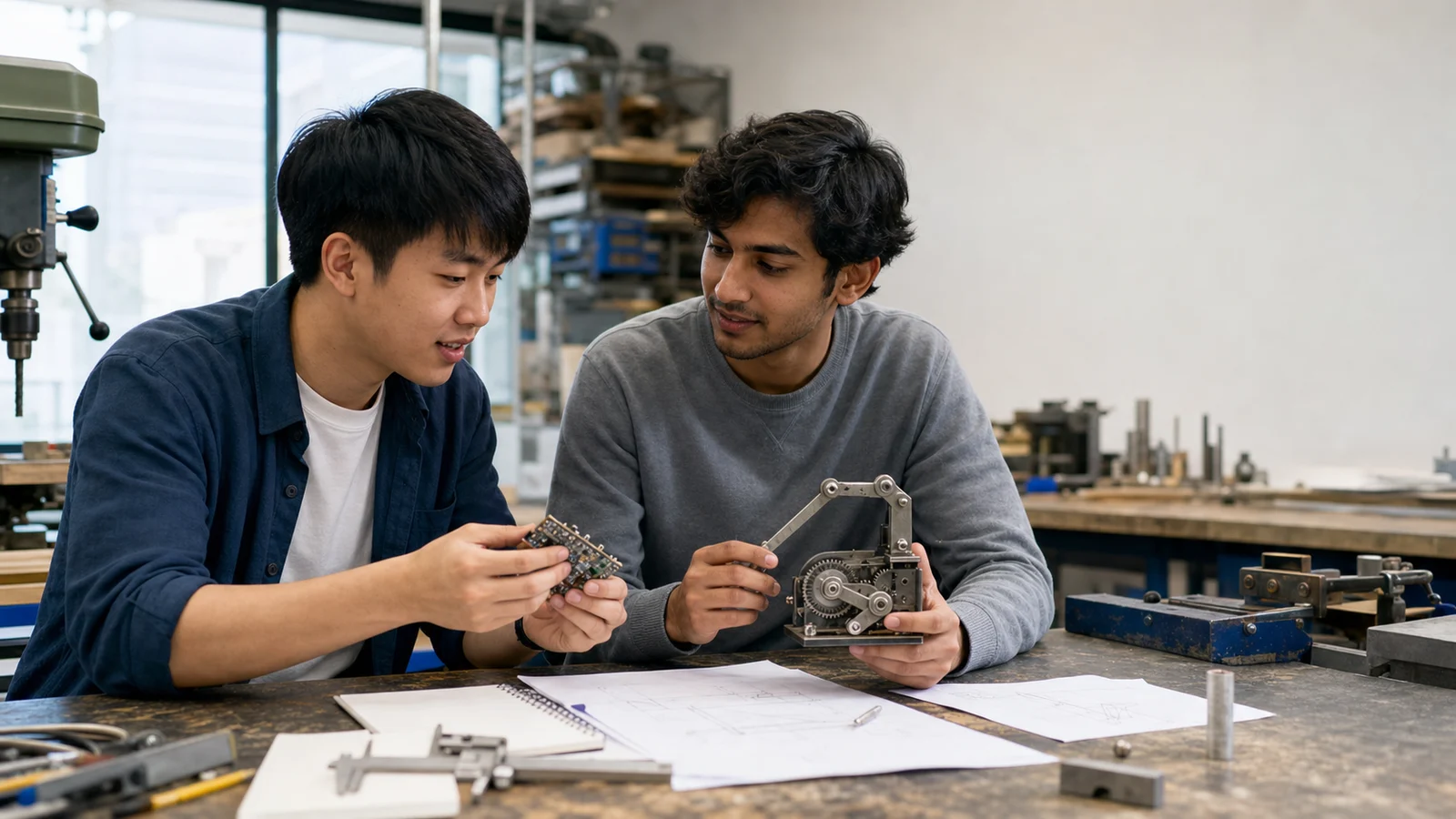
Electrical and mechanical engineering share mathematics, physics, design and responsibility for safety, but they work with different physical systems. Electrical engineering centres on circuits, electronics, signals, power, control and communication. Mechanical engineering centres on forces, motion, materials, energy, fluids, heat and machines.
Both current Univs examples are four-year English-taught bachelor’s programmes, which makes the comparison more direct. Still, module depth, laboratories, accreditation and final projects differ. Choose from the actual engineering work rather than from broad industry lists. Review semester-by-semester prerequisites as well, because later design modules often depend on a precise mathematics and physics sequence.
The shortest useful answer
Choose electrical engineering if circuits, signals, electronics, control or power systems hold your attention. Choose mechanical engineering if motion, machines, thermodynamics, fluids, materials and manufacturing interest you more. Both require sustained calculations, experiments and design verification.
The current study level is comparable
The highlighted Univs options are bachelor’s programmes of the same listed duration. That does not guarantee identical credits, calendars or professional standing. Check the current curriculum, award title and institutional documentation before treating duration as the decisive difference.
Where the programmes overlap
Calculus, differential equations, physics, materials, computing, control, design, laboratories and teamwork may appear in both. Electrical systems can control mechanical devices, while mechanical designs rely on sensors and power. The advanced required modules reveal where each degree places its centre of gravity.
Electrical engineering studies signals and circuits
Electrical curricula commonly develop circuit analysis, electronics, digital systems, signals, electromagnetics, communications, power or control. Laboratory work connects models with measurement. Ask how students progress from basic components to integrated systems and how much individual access they have to equipment.
Mechanical engineering studies motion and energy
Mechanical curricula commonly develop statics, dynamics, thermodynamics, fluids, heat transfer, machine design, materials and manufacturing. Projects may involve moving parts or energy conversion. Inspect how design-build-test work is supervised and whether models are validated experimentally.
The physics feels different
Electrical students reason about voltage, current, fields, signals and information. Mechanical students reason about force, motion, pressure, temperature and deformation. Both use abstraction, and both require unit discipline. Try representative problems from each area before judging fit from a laboratory photograph.
Laboratories answer different questions
Electrical laboratories may measure circuits, signals, machines, communications or embedded systems. Mechanical laboratories may test materials, fluids, heat, vibration or mechanisms. Ask how uncertainty is reported, how safety is assessed and whether each student performs meaningful work rather than observes a demonstration.
Design projects should include verification
An electrical project should justify architecture, components, signals, power and testing. A mechanical project should justify loads, materials, geometry, manufacture and performance. In both, a polished model is incomplete without requirements, calculations, validation, risk analysis and documentation.
Computing supports both disciplines
Electrical engineers may program embedded devices, analyse signals or simulate circuits. Mechanical engineers may model systems, automate design or control machinery. Check whether computing is taught as a transferable engineering method rather than a collection of software buttons.
Facilities and consumables matter
Electrical study may depend on benches, instruments, components and safe power access. Mechanical study may depend on workshops, testing rigs, fabrication and materials. Ask about booking, supervision, replacement parts and project costs. A facility tour should be matched to actual student access, including how frequently required equipment is available during assessed project periods.
Professional recognition is destination-specific
Engineering titles and registration paths differ by country. An institution or programme may require separate recognition, examinations or experience elsewhere. Verify the exact award and graduation year with the relevant authority. Do not assume the word engineering grants a protected title internationally.
Questions to ask yourself
Would you rather trace a signal through a circuit or forces through a mechanism? Which laboratories would you willingly repeat when results fail? Do you enjoy electromagnetics and electronics, or thermodynamics and mechanics? Are you prepared for the mathematics and safety discipline in either route?
A practical comparison exercise
Choose an electric lift. Map the electrical questions around power, sensing, control and communication. Then map the mechanical questions around loads, motion, materials and braking. Compare both curricula and note which side gives you more problems you genuinely want to solve.
Common comparison mistakes
Do not reduce electrical engineering to wiring or mechanical engineering to vehicle repair. Avoid salary comparisons and spectacular project imagery. Do not assume overlapping first-year modules make the degrees interchangeable. Compare advanced courses, laboratory access, capstone responsibility and recognition.
Final comparison checklist
- I compared circuits and signals with mechanics and thermal systems.
- I reviewed laboratory access and capstone verification.
- I tested my interest with representative physics problems.
- I checked professional recognition in my intended destination.
- I chose a technical problem set rather than an industry stereotype.
Review Electrical and Electronic Engineering at Ilia State University, compare it with Mechanical Engineering at GTU and inspect more routes in the Univs programme catalogue. Recheck recognition before applying.
Editorial note
Requirements can change and may differ by institution, programme and applicant. Recheck current university and government guidance before paying or travelling.
For comparisons, we assess the stated student brief, current route availability, discovery breadth, application ownership, progress visibility, support, costs and duplicate-application risk. Univs publishes this page and may have commercial relationships with institutions; those relationships do not determine admission decisions. Read our editorial standards.