

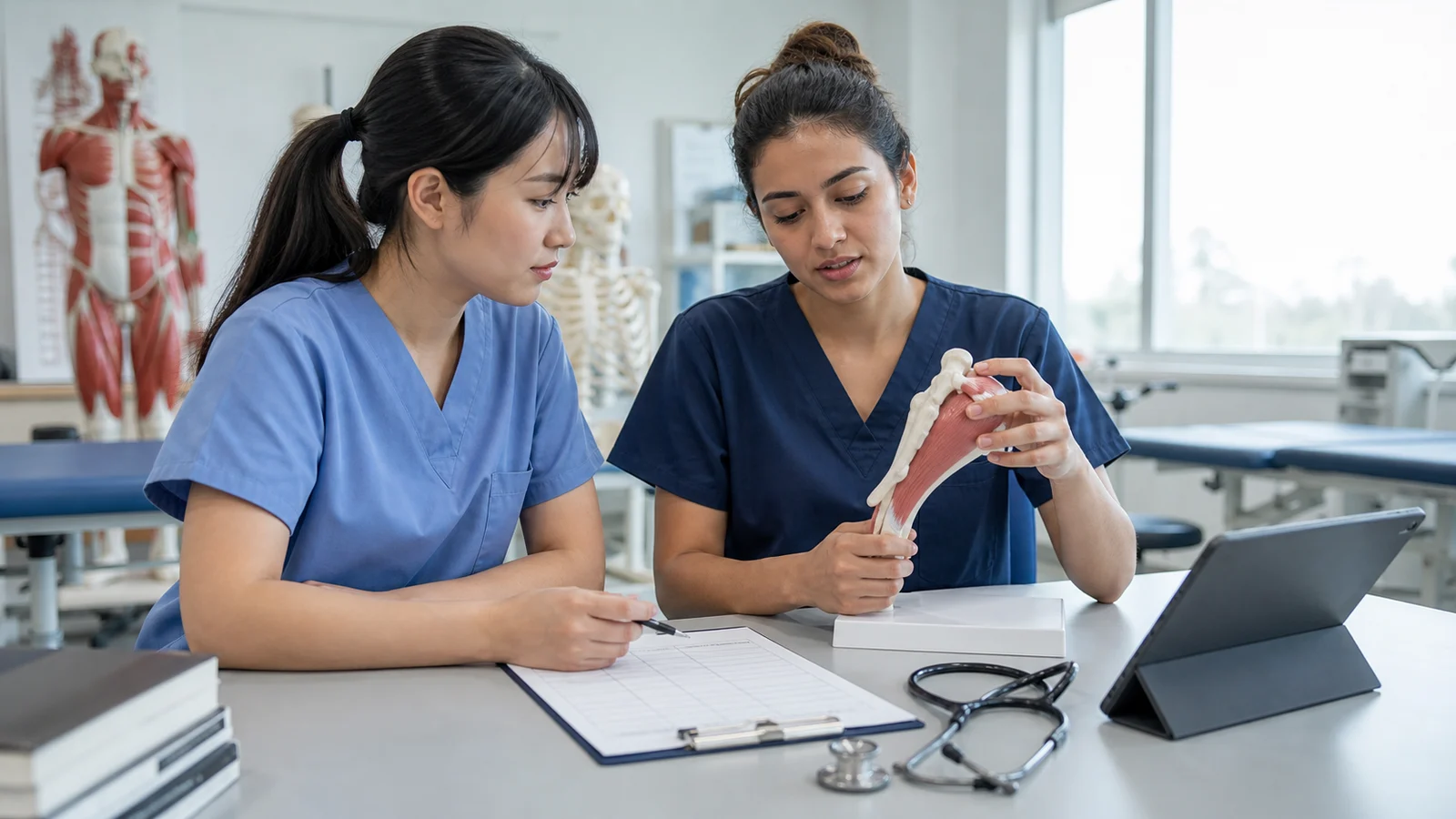
Nursing and physical medicine and rehabilitation both support health, function and patient wellbeing, yet the available bachelor’s programmes prepare students for different responsibilities. Nursing centres on comprehensive nursing care across settings. TSMU’s Physical Medicine and Rehabilitation programme is a bachelor’s allied-health route focused on function and rehabilitation; it is not a medical-doctor specialty programme.
This distinction is especially important for international applicants. Professional titles, registration and scope of practice differ by country. Compare the exact qualification, clinical sequence and destination regulator before assuming either Georgian degree leads automatically to a particular role abroad.
The shortest useful answer
Choose nursing if you want broad patient-care responsibility, observation, clinical judgement and coordination across health settings. Choose physical medicine and rehabilitation if you are drawn to movement, function, recovery and rehabilitation planning within the scope of the exact allied-health award. Neither route is a shortcut to becoming a doctor.
Both current options are bachelor’s programmes
The Univs catalogue currently presents both routes as four-year bachelor’s programmes taught in English. That similarity helps with timing but says little about professional equivalence. Check credits, practice hours, qualification title and admission requirements in the current institutional documents.
Nursing develops broad care responsibility
Nursing curricula commonly include assessment, pathophysiology, pharmacology, adult care, maternal and child health, mental health, community care, ethics and evidence-based practice. Students learn to monitor change, communicate risk and coordinate care. The exact clinical placements and legal scope must be verified.
Rehabilitation focuses on function and participation
Physical medicine and rehabilitation study can emphasise anatomy, movement, therapeutic activity, functional assessment and recovery across different conditions. Review the TSMU curriculum rather than importing the meaning of a similarly named physician specialty from another country. Qualification titles and scopes are not universal.
Where the programmes overlap
Anatomy, physiology, communication, ethics, evidence-based practice and teamwork can appear in both. Nurses may contribute to rehabilitation, and rehabilitation practitioners may work alongside nursing teams. Shared settings do not mean identical clinical authority, assessment methods or registration routes.
Patient contact has a different rhythm
Nursing may involve continuous observation, medication-related responsibilities, care planning and response to changing needs. Rehabilitation encounters may focus more on structured functional goals, movement and progress over time. Ask what students do under supervision rather than relying on general descriptions of helping patients.
Clinical learning must be documented
Request the current practice sequence, settings, supervision arrangements, required hours and assessment method. A teaching room or partner-hospital list does not prove the depth of individual experience. Check what happens if a placement is delayed or a required competency is not completed.
Physical demands deserve honest review
Both routes can involve standing, communication under pressure and safe assistance with movement. Nursing may add shift-based care and rapidly changing priorities. Rehabilitation may involve repeated demonstration and movement analysis. Ask about reasonable adjustments and technical standards before assuming practical requirements will be easy.
Assessment should test safe judgement
Written examinations alone cannot demonstrate practical competence. Compare simulation, observed skills, clinical evaluation, reflective work and research. Ask how students receive feedback and how safety concerns are handled. The purpose is not to collect procedures, but to make appropriate decisions within a defined role.
Language affects real clinical learning
An English-taught classroom does not remove the need to communicate with patients, supervisors and local teams. Ask what Georgian-language preparation is provided and what level is expected before placements. Communication needs can affect both learning and safety even when the formal programme language is English.
Recognition must be checked separately
Nursing and rehabilitation professions are regulated differently across destinations. The relevant authority may examine programme content, practice hours, language, examinations or supervised experience. Check the exact institution, award and graduation year. Do not rely on a general claim that a programme is internationally recognised.
Questions to ask yourself
Do you want broad nursing care across changing patient needs, or sustained work on function and rehabilitation goals? How do you respond to clinical uncertainty, close patient contact and physical practice? Are you willing to meet language and registration requirements in your intended country?
A practical comparison exercise
Map one recovery journey after a serious injury. List nursing responsibilities for monitoring, care, education and coordination. Then list rehabilitation responsibilities for functional assessment, movement and progression. Compare curricula to see where each competence is taught, supervised and assessed.
Common comparison mistakes
Do not call nursing general medicine or describe the TSMU rehabilitation bachelor’s as physician training. Avoid comparing only uniforms, facilities or programme length. Do not assume shared patient contact creates the same scope of practice. Verify clinical hours, qualification titles and destination recognition.
Final comparison checklist
- I confirmed the exact bachelor’s qualification for both programmes.
- I compared clinical responsibilities, placements and practical assessment.
- I understand that the rehabilitation route is not a medical-doctor specialty.
- I checked language and destination-specific professional recognition.
- I will not rely on generic claims about international acceptance.
Compare Nursing at SEU with Physical Medicine and Rehabilitation at TSMU, then review further options in the Univs programme catalogue. Confirm clinical and recognition requirements before applying.
Editorial note
Requirements can change and may differ by institution, programme and applicant. Recheck current university and government guidance before paying or travelling.
For comparisons, we assess the stated student brief, current route availability, discovery breadth, application ownership, progress visibility, support, costs and duplicate-application risk. Univs publishes this page and may have commercial relationships with institutions; those relationships do not determine admission decisions. Read our editorial standards.