

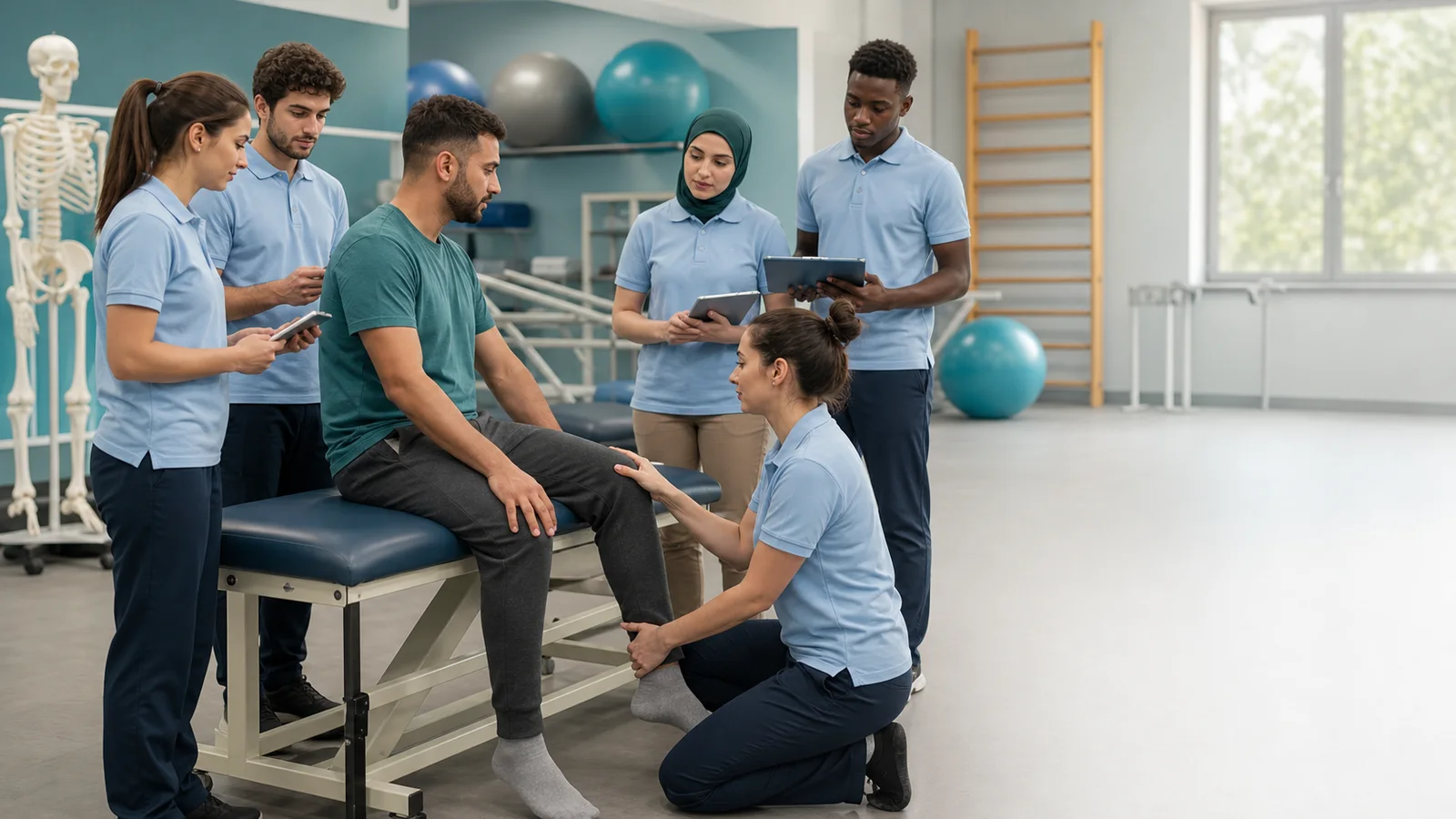
Physical Medicine and Rehabilitation is a health-profession field concerned with function, movement, participation and quality of life. It should not be confused with a medical-doctor specialty programme, a short fitness course or an automatic licence to practise in another country.
The current Univs catalogue lists an English-taught bachelor’s route at Tbilisi State Medical University (TSMU). Because professional scope and recognition are consequential, this guide is an educational comparison and requires a final human factual review before publication.
What is Physical Medicine and Rehabilitation?
At bachelor’s level, the field can cover anatomy, physiology, movement, functional assessment, therapeutic exercise, rehabilitation methods and work with people affected by illness, injury or disability. Students need both scientific foundations and supervised practical learning.
The exact professional title and permitted scope differ between countries. Applicants should not assume the degree is identical to medicine, physiotherapy or another regulated profession in their intended destination.
Which programme is currently listed?
Univs lists Physical Medicine and Rehabilitation at Tbilisi State Medical University as a four-year bachelor’s programme taught in English. Current TSMU programme information describes a Bachelor of Physical Medicine and Rehabilitation, 240 ECTS and eight semesters.
Use the live programme page for the current tuition, application charge, intake and document requirements. Obtain formal confirmation before paying.
How is it different from an MD programme?
An MD programme educates medical doctors across broad biomedical and clinical disciplines before later professional and specialist steps. A bachelor’s in Physical Medicine and Rehabilitation has a different qualification and educational purpose.
If you intend to become a doctor, read the Medicine study guide and verify the medical pathway required in your country. Do not select this bachelor’s as a presumed shortcut to an MD.
How is it different from physiotherapy?
There may be overlapping subjects, but naming, curriculum and legal scope are determined by each education and professional system. Ask TSMU for the current graduate profile and contact the regulator or credential authority in the country where you hope to practise.
Use the exact award title in every recognition enquiry. A general description of “rehabilitation study” is not precise enough.
What scientific foundations should be present?
Look for anatomy, physiology, pathology, biomechanics, movement science and clinical reasoning. Later study may cover therapeutic exercise, assessment, orthopaedic and neurological conditions, assistive approaches and rehabilitation across age groups.
Ask how theory is sequenced before practice and how competence is assessed. Attendance expectations may be strict in practical and clinical subjects.
What practical training should you verify?
Request written information about skills laboratories, supervised placements, clinical settings, hours and assessment. Find out who supervises students and what language is used with patients or staff. English-medium classroom teaching does not necessarily mean every placement interaction is in English.
Students must respect consent, privacy, infection control and professional boundaries. Patient identities and records should never be used in public assignments.
Who may be a good fit?
The degree may suit a student interested in health science, movement and long-term patient progress. Patience, communication, physical stamina and comfort with close supervised practice are important. Academic preparation in biology and related sciences can help.
Applicants should consider whether they are comfortable working with people experiencing pain, disability or complex health conditions and whether the professional scope matches their goal.
How should professional recognition be checked?
Before applying, contact the regulator, health authority or credential body in the country where you may work. Provide the exact university, award title, duration, credit volume and curriculum. Ask whether additional examinations, supervised practice, language evidence or further education would be required.
Obtain written, current information. Recognition can change and may depend on individual documentation; neither Univs nor a university can guarantee another authority’s decision.
What careers or further study may follow?
Possible settings may include rehabilitation services, health and fitness organisations, community programmes or further academic study, subject to local professional rules. The degree does not by itself guarantee a particular protected title or clinical role.
Ask TSMU about graduate outcomes in aggregate and the postgraduate routes for which the bachelor’s is academically acceptable.
What should the full budget include?
Plan for four years of tuition, application charges, accommodation, food, transport, insurance, immigration expenses, travel, study materials, uniforms and possible health or placement requirements. Ask whether vaccinations, checks or equipment create extra costs.
Confirm payment schedules and refund terms in writing. Do not make non-refundable travel arrangements until admission and immigration steps are complete.
Questions to ask before applying
- What exact qualification is awarded?
- How many supervised practical or clinical hours are included?
- Which languages are used during placements?
- How are practical competencies assessed?
- What does my destination regulator require?
- What is the complete four-year cost, including placement needs?
Is this rehabilitation degree right for you?
It may be appropriate if you want a four-year health-science bachelor’s focused on function and rehabilitation, understand that it is not an MD and have checked the professional pathway in your destination. Review Tbilisi State Medical University, compare the Nursing study guide and use the current catalogue. A human reviewer should confirm the recognition wording before this draft is considered for publication.
Editorial note
Requirements can change and may differ by institution, programme and applicant. Recheck current university and government guidance before paying or travelling.
For comparisons, we assess the stated student brief, current route availability, discovery breadth, application ownership, progress visibility, support, costs and duplicate-application risk. Univs publishes this page and may have commercial relationships with institutions; those relationships do not determine admission decisions. Read our editorial standards.