

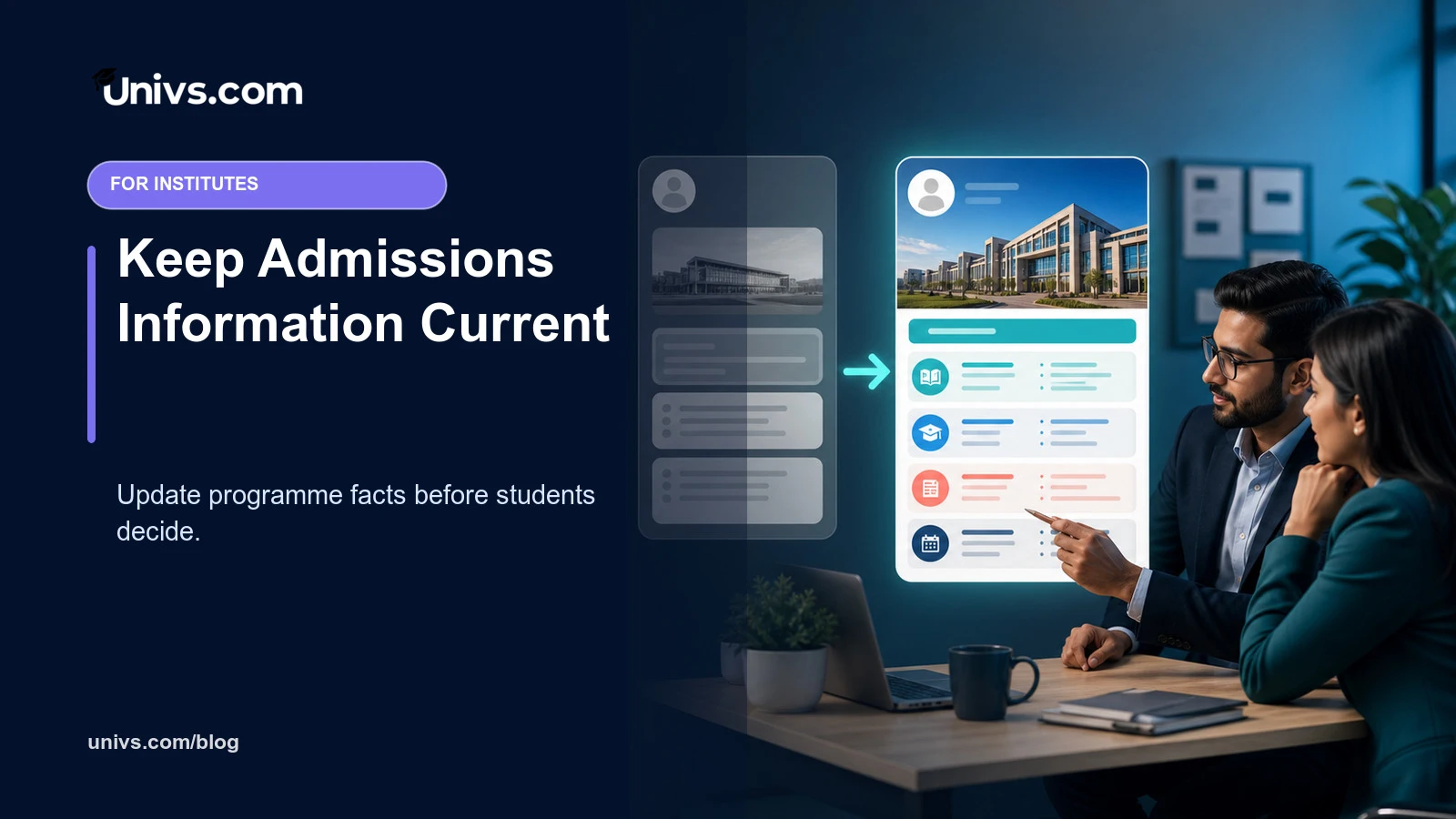
Institute profiles change as programmes, contacts, fees, deadlines and student services change. Directly editing live information without review can create accidental contradictions, while waiting for an annual update leaves students relying on old facts.
The Univs institute workspace supports controlled profile and admissions drafts where enabled. Institute representatives can prepare content and submit changes for staff review instead of silently replacing the public record.
A review workflow improves control, but the institute must still provide authoritative, dated information and respond when a proposed change is questioned.
The short answer
Univs helps institutes keep information current by separating editable drafts from the approved public profile. Teams can organise institutional content, admissions requirements and support information, then submit changes through a reviewed workflow that protects the live record from unapproved edits.
How the benefit works
| Institute need | Useful Univs role |
|---|---|
| Prepare changes safely | Work in a draft without immediately changing the public profile |
| Separate content areas | Review institutional and admissions information with the right owners |
| Record approval state | Show whether changes are saved, submitted or reviewed |
| Maintain accountability | Keep an audit trail for consequential profile updates |
Drafts protect the current public record
An institute representative should be able to prepare a correction without exposing half-complete content. A draft keeps the existing approved profile visible until the change is ready. This is especially important when one update depends on confirmation from academic, finance or admissions teams.
Institutional content needs a named owner
Identity, contact details, institution type, description and distinguishing features should come from the responsible office. Marketing teams can improve clarity, but they should not invent authorisation, accreditation or outcome claims. Source ownership helps reviewers ask the right department when evidence is missing.
Admissions information changes at different speeds
Requirements, document lists, intakes, deadlines, accommodation guidance and cost context do not always change together. The profile should preserve separate fields and review dates so one current deadline does not make an older document list appear refreshed automatically.
Programme data and profile data must agree
The institution profile may state general admissions principles, while the programme record contains the exact route. Conflicts between level, language, fees or intake create more harm when both pages look authoritative. Teams should test the relationship before submitting either update.
Structured fields make missing information visible
Free-form text can hide whether a profile includes support, costs, application steps or document requirements. Structured sections expose gaps and make review easier. A blank field should be labelled for confirmation rather than filled with a generic statement borrowed from another institution.
Submission should trigger evidence review
A pending-review state is not a public approval. The reviewer should check the proposed value, source, scope and date, especially for fees, admissions, accreditation or immigration-related statements. If evidence is incomplete, the change should remain out of the public profile until resolved.
Withdraw and correction routes reduce pressure
Teams need a safe way to withdraw an unapproved draft or correct it after feedback. This allows representatives to improve the submission without bypassing review. An approved change should follow a controlled correction process rather than being casually deleted because someone changed their mind.
A review calendar prevents emergency updates
Institutes can schedule profile checks before major intakes, fee decisions and programme launches. Regular review reduces last-minute corrections and gives responsible offices time to verify claims. The public profile becomes a maintained service rather than a brochure that happens to be online.
How institute teams should use this well
Create a field-owner matrix for institutional content, admissions, fees, programmes and student support. Add source dates, prepare changes in draft and require the responsible owner to confirm consequential fields before submission. Review the public preview and application route together after approval.
What still belongs to the institution
The institute owns the truth of its identity, programmes, requirements, fees, deadlines and services. Univs can provide draft, review and audit structures, but it cannot approve an academic change on the institution’s behalf or make unsupported information safe because it passed through a form.
Questions to ask during onboarding
- Which office owns each profile field?
- What source and date support the proposed change?
- Does the programme page agree with the institute profile?
- Who reviews consequential admissions or fee information?
- How will approved information be rechecked before the next intake?
A practical next step
Export or copy the current profile headings into an ownership sheet. Mark each field current, outdated, conflicting or unknown, then assign evidence and a reviewer. Submit one complete, traceable update package rather than many isolated corrections without context.
Final perspective
Univs helps institutes maintain public information through a safer path from draft to review. The workflow protects clarity only when institutional teams treat every consequential field as owned, dated evidence rather than permanent marketing copy.
Continue with the institute profile overview, current public institute profiles, the connected programme catalogue and the transparency principles behind Univs.
Editorial note
Requirements can change and may differ by institution, programme and applicant. Recheck current university and government guidance before paying or travelling.