

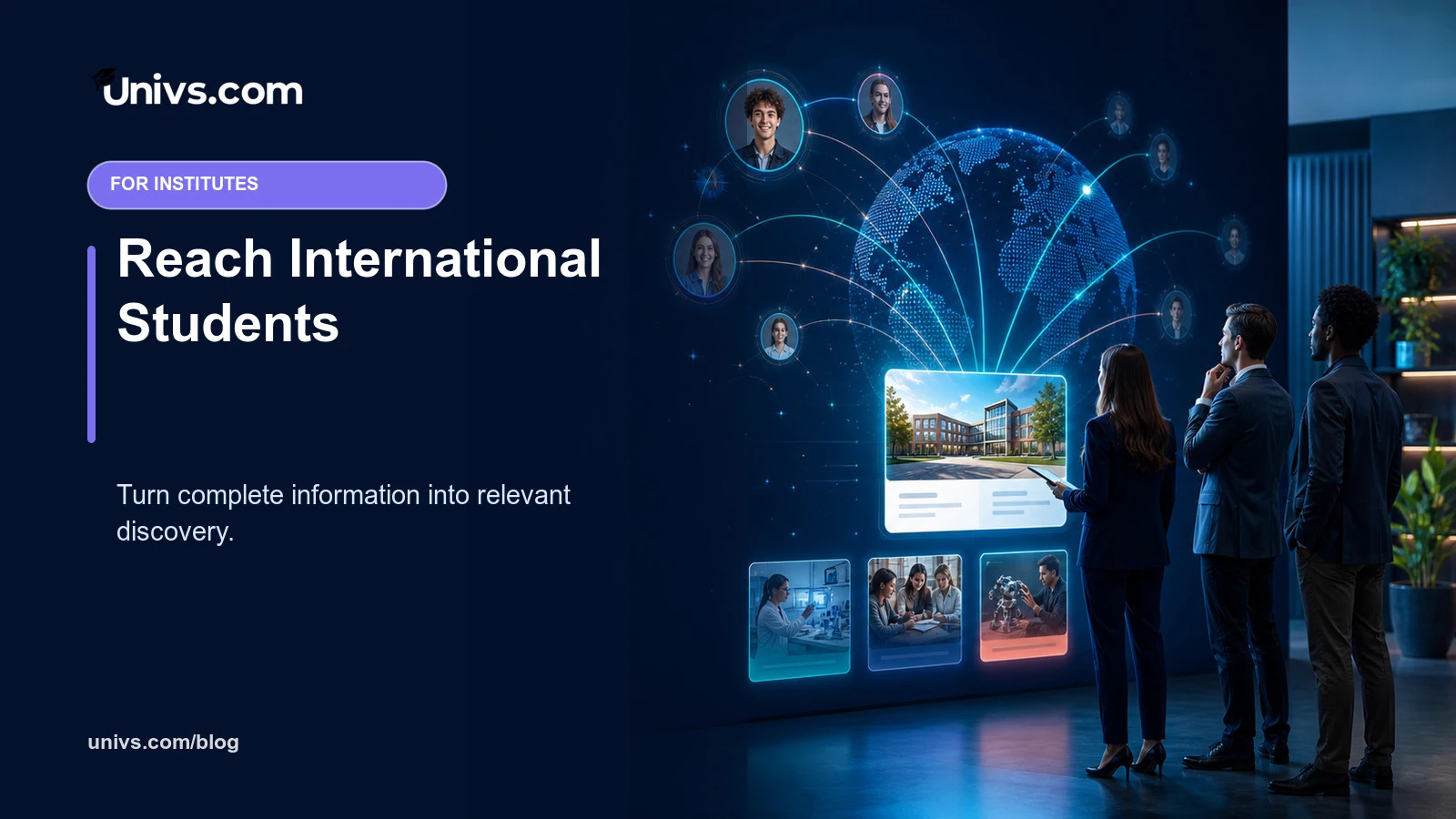
A strong programme cannot attract the right international student if the student cannot find it, understand it or confirm how to take the next step. Institute visibility is therefore more than appearing in a directory. It requires an accurate profile, structured programme data and a current enquiry or application route.
Univs connects institute profiles with programme search and international student discovery. The platform can help an institution appear when a student searches by subject, country, level, language, duration or tuition range rather than only by a famous university name.
That visibility is an opportunity, not a guarantee. Search exposure cannot promise applications, admission quality or enrolment. The institute still needs relevant programmes, clear information and a responsive admissions process.
The short answer
Univs helps institutes reach international students by turning institutional and programme information into searchable, comparable records. A student can discover an unfamiliar institution through the programme that fits their criteria, then move to the institute profile and current contact or application route.
How the benefit works
| Institute need | Useful Univs role |
|---|---|
| Be discoverable beyond brand searches | Connect programmes to subject, location, language and study-level searches |
| Explain the institution | Use one profile for identity, support, facilities and admissions context |
| Show the next step | Connect relevant programmes to an available enquiry or application route |
| Learn from activity | Review aggregate interest and application patterns where reporting is enabled |
Discovery begins with programme intent
Many prospective students begin with a subject, qualification level, destination or budget. A structured Univs programme record gives the institute a route into those searches even when the student has never typed its name. This supports discovery based on fit, while the institution remains responsible for keeping the programme identity and availability accurate.
A complete profile turns exposure into understanding
Visibility without context can create weak enquiries. The institute profile should explain the institution type, location, educational focus, support, facilities and admissions contact alongside the programme catalogue. When these fields are consistent, a student can decide whether to investigate further before asking the admissions team to repeat basic information.
Specific programmes create stronger entry points
A general university page cannot answer every academic question. Separate programme pages allow titles, awards, curriculum context, tuition, duration, language and entry requirements to be connected to the right route. This makes search visibility more useful because the landing page reflects the student’s actual study intention.
Search visibility depends on current information
An old fee, closed intake or incomplete requirement can attract the wrong traffic. Institute teams should treat programme publishing as an operational responsibility, not a one-off marketing task. Source dates, responsible owners and a review calendar help prevent a visible page from becoming a source of avoidable confusion.
Smaller and specialised institutions can explain their fit
International discovery should not depend only on institutional fame. A specialist academy, regional university or focused college can describe the programmes and learning environment that make it relevant to a particular student. The platform gives that evidence a consistent structure without asserting that every institution is suitable for everyone.
Internal links build a connected discovery journey
A student may move from a country page to a programme, then to the institute profile and an application explanation. Natural connections between those pages help users understand the relationship instead of opening unrelated marketing tabs. Each link should describe its destination and support a real question rather than exist only for search engines.
Visibility can be measured but not overinterpreted
Views, enquiries and application starts can show where interest appears, but small samples do not prove programme quality or future enrolment. Institute teams should compare periods, destinations and programme categories carefully, preserve zeroes and investigate changes before altering academic or recruitment strategy.
Optional promotion should remain separate from accuracy
Additional visibility can be useful, but a featured placement should never replace complete programme information or imply academic superiority. Whether discovery is organic or promoted, the student should see the same accurate fees, requirements, source dates and application availability. Trust is weakened when promotion and evidence are allowed to contradict each other.
How institute teams should use this well
Assign an owner for the institute profile and another for programme-level facts, then agree a simple review schedule. Check what a student sees before every main intake, confirm the application route and record unresolved fields. Use reporting to form questions, not to manufacture success claims from a small number of impressions or applications.
What still belongs to the institution
The institution controls its programme offering, admissions criteria, academic decisions, response standards and formal communications. Univs can provide discovery and workflow infrastructure, but it cannot create demand for an unsuitable programme, guarantee search positions, admit students, award qualifications or replace the institution’s legal and regulatory responsibilities.
Questions to ask during onboarding
- Which student searches should lead to each programme?
- Who owns the accuracy of profile and programme fields?
- How often will fees, intakes and requirements be reviewed?
- Which enquiry or application route is currently operational?
- What level of evidence is needed before acting on a visibility metric?
A practical next step
Choose one priority programme and trace the entire public journey: search criteria, programme page, institute profile and current application route. Record every missing or conflicting field and assign an owner. Improving one complete journey is more useful than adding many shallow listings that cannot support a decision.
Final perspective
Univs can expand an institute’s international visibility by connecting it to the searches students already make. The lasting benefit comes from discoverability joined to evidence: accurate programme data, a trustworthy institution profile and a clear next step maintained by the institute.
Continue with the Univs institute partnership overview, the public programme catalogue, the institute directory and the student discovery journey.
Editorial note
Requirements can change and may differ by institution, programme and applicant. Recheck current university and government guidance before paying or travelling.