

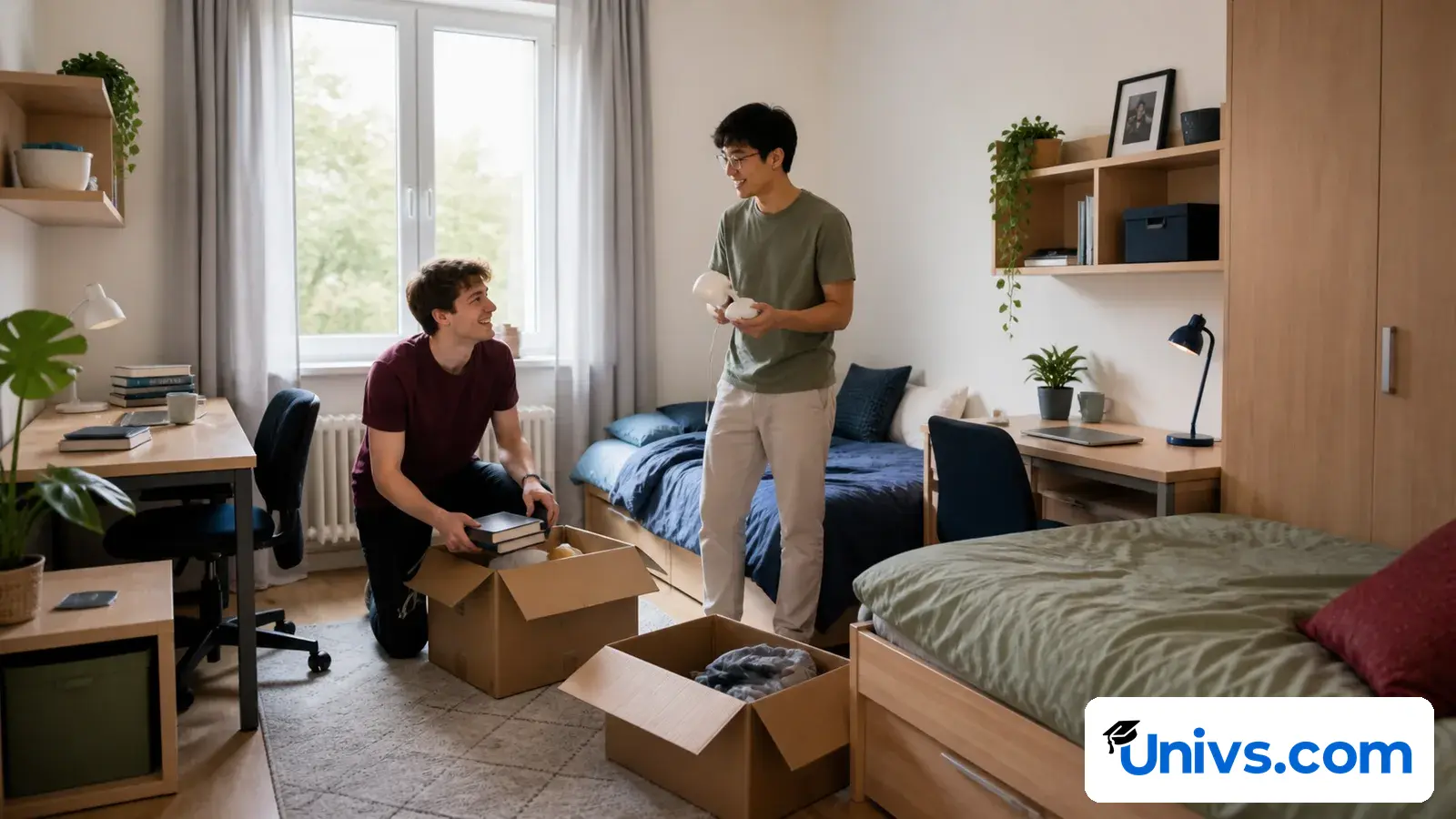
International students in Czechia usually choose a university dormitory, a room in a shared flat or a private flat. Dormitories are often the simplest and lower-cost start, but places are limited and standards vary. Current official 2026 guidance lists shared dorm rooms around €160–€330 per month and single dorm rooms around €250–€450. A room in a shared flat is indicated around €250–€500, while a small private flat can be roughly €500–€900 outside a city centre or €600–€1,000 centrally. These are indicative ranges, with Prague and Brno often at the higher end. Compare the total including utilities, deposit and agency fee, verify the landlord and property, read the contract, and confirm that the accommodation document satisfies any visa or residence requirement before transferring money.
Czech student housing options compared
| Question | Planning answer | What can change |
|---|---|---|
| Shared dorm room | About €160–€330 monthly. | City, building, provider and room. |
| Single dorm room | About €250–€450 monthly. | Limited supply and facilities. |
| Room in shared flat | About €250–€500 per person monthly. | Utilities, location and household size. |
| Small flat outside centre | About €500–€900 monthly. | City, size, condition and inclusions. |
| Small flat in centre | About €600–€1,000 monthly. | Prague/Brno and market conditions. |
Dormitories are a practical first landing, not one product
Public universities commonly offer dormitories, usually with basic furniture and shared facilities. Utilities and Wi-Fi are often included, but room type, bathroom arrangement, kitchen, equipment, quiet hours and visitor rules vary by building. Private institutions may refer students to external residences instead of operating their own.
Ask the university about eligibility, application opening, allocation date, contract length and cancellation. A place may not be automatic with admission. If you need an accessible room, family housing or specific medical accommodation, contact the provider early and obtain written confirmation.
Shared flats trade simplicity for choice
A shared flat can offer more privacy and location choice while dividing rent and utilities. Clarify whether you rent an individual room directly from the owner, sublet from another tenant or share one joint lease. That affects deposit responsibility, notice and what happens if a housemate leaves.
Meet housemates where possible and agree on utilities, cleaning, visitors and shared purchases. Inspect the room and common areas by live video or in person. A polished listing does not prove the advertiser controls the property.
Private flats concentrate cost and responsibility
A private flat provides independence but usually costs more and can require the tenant to arrange utilities, internet and household items. The advertised amount may exclude service charges, electricity, heating, water, waste or building fees. Request the expected monthly advance and how annual reconciliation works.
Read the fixed term, renewal, notice, deposit-return, damage, repair and guest clauses. Inventory the condition with dated photos at handover. If the contract is only in Czech, obtain reliable translation or advice before signing rather than relying on a verbal summary.
A lower rent can hide a costly commute
Measure the route to the actual faculty, not only the university’s main address. Check early-morning and evening public transport, transfer reliability and the cost of a pass for your age and student status. A 40-minute direct tram can be easier than a shorter route with unreliable connections.
Consider groceries, healthcare, study spaces and safe late arrival. “Central” is not automatically better, and a smaller city can offer lower rents with different employment and social options. Base the choice on the week you will live, not a tourist weekend.
Verify before paying a deposit
Use a provider listed by the university or verify the owner or authorised agent, address and contract independently. Ask for a live viewing showing access from the street and the specific room. Reverse-searching images and checking whether identical photos appear under multiple addresses can reveal copied listings.
Pay to the contracted party using a traceable method only after identity, authority and terms are clear. Be cautious of urgency, cryptocurrency, gift cards, overpayment refunds or requests to send passport data before legitimacy is established. Keep the listing, messages, contract and receipt.
Immigration accommodation evidence has its own format
Third-country visa or residence applicants normally need proof of accommodation. The Ministry’s route pages and embassy instructions control the acceptable document, signer, certification and period. A booking screenshot or informal message may not be enough even if it reserves a bed.
Ask the provider whether it issues the official confirmation and when. Ensure names, address and stay dates match the application. Do not choose a route solely because a landlord promises “visa papers”; verify the format against the authority’s current requirement.
Plan a safe arrival and handover
Confirm check-in hours, late-arrival procedure, keys, first payment and temporary alternatives if travel is delayed. Carry the provider’s verified contact details and address. Avoid arriving with no lawful place to stay because a private host stopped replying.
At handover, record meter readings, keys, furniture and existing damage. Ask how defects are reported and keep written evidence. Register the address or complete later immigration duties as required for your status, even if the accommodation provider handles an initial report.
Housing decisions that deserve a pause
Urgency and an attractive price are common pressure points.
-
Assuming admission includes a dorm bed.
-
Comparing rent without utilities and deposits.
-
Paying before verifying the owner, property and contract.
-
Accepting a prerecorded viewing as proof of control.
-
Ignoring contract language or notice terms.
-
Choosing by city centre alone without testing the commute.
-
Assuming any booking receipt satisfies immigration.
What to verify before you decide
Use this list before transferring a deposit or relying on the address for immigration.
-
Provider identity and authority to let the room.
-
Exact room, address and live condition.
-
Rent, utilities, deposit, fees and due dates.
-
Contract term, cancellation, notice and deposit return.
-
Furniture, internet, accessibility and house rules.
-
Commute to the actual study site.
-
Accepted accommodation evidence for your immigration route.
-
Check-in, inventory and address-reporting process.
Questions students ask before committing
These answers are intentionally brief. Where a rule depends on your passport, programme or year, use the linked authority or ask the responsible institution for a written answer.
How much is a Czech student dormitory?
Official 2026 guidance indicates about €160–€330 for a shared room and €250–€450 for a single room monthly, with substantial variation.
Are dormitories guaranteed to admitted students?
No general guarantee exists. Places and allocation rules differ by university and building, so apply through the official housing process early.
Is Prague student accommodation more expensive?
Prague and Brno are generally at the higher end of official ranges. Actual rent depends on room, location, condition and included services.
How much deposit will I pay?
Private deposits and possible agency fees vary by contract. Request the exact amount, legal basis, return conditions and receipt before payment.
Can I use a short-term booking for my visa?
Only if it meets the immigration authority’s required proof format and period. A consumer booking confirmation may not be sufficient.
How can I reduce rental scam risk?
Verify the owner or authorised agent, insist on a live property check, read the contract, use traceable payment and reject unusual payment or urgency tactics.
Are utilities normally included?
Dormitory prices often include utilities and Wi-Fi; private rents may not. Ask for every recurring charge and the reconciliation method.
Take a measured next step
Keep your planning in the Univs journey: contact the Univs team. Apply for official dormitory housing while comparing two verified alternatives. Score each on total monthly cost, deposit exposure, commute, contract flexibility and immigration-document suitability. Univs supports planning; the university, Czech authority, embassy and other responsible provider remain the decision-makers for admission, recognition, immigration and regulated services.
Primary sources
Editorial note
Requirements can change and may differ by institution, programme and applicant. Recheck current university and government guidance before paying or travelling.
For comparisons, we assess the stated student brief, current route availability, discovery breadth, application ownership, progress visibility, support, costs and duplicate-application risk. Univs publishes this page and may have commercial relationships with institutions; those relationships do not determine admission decisions. Read our editorial standards.


