

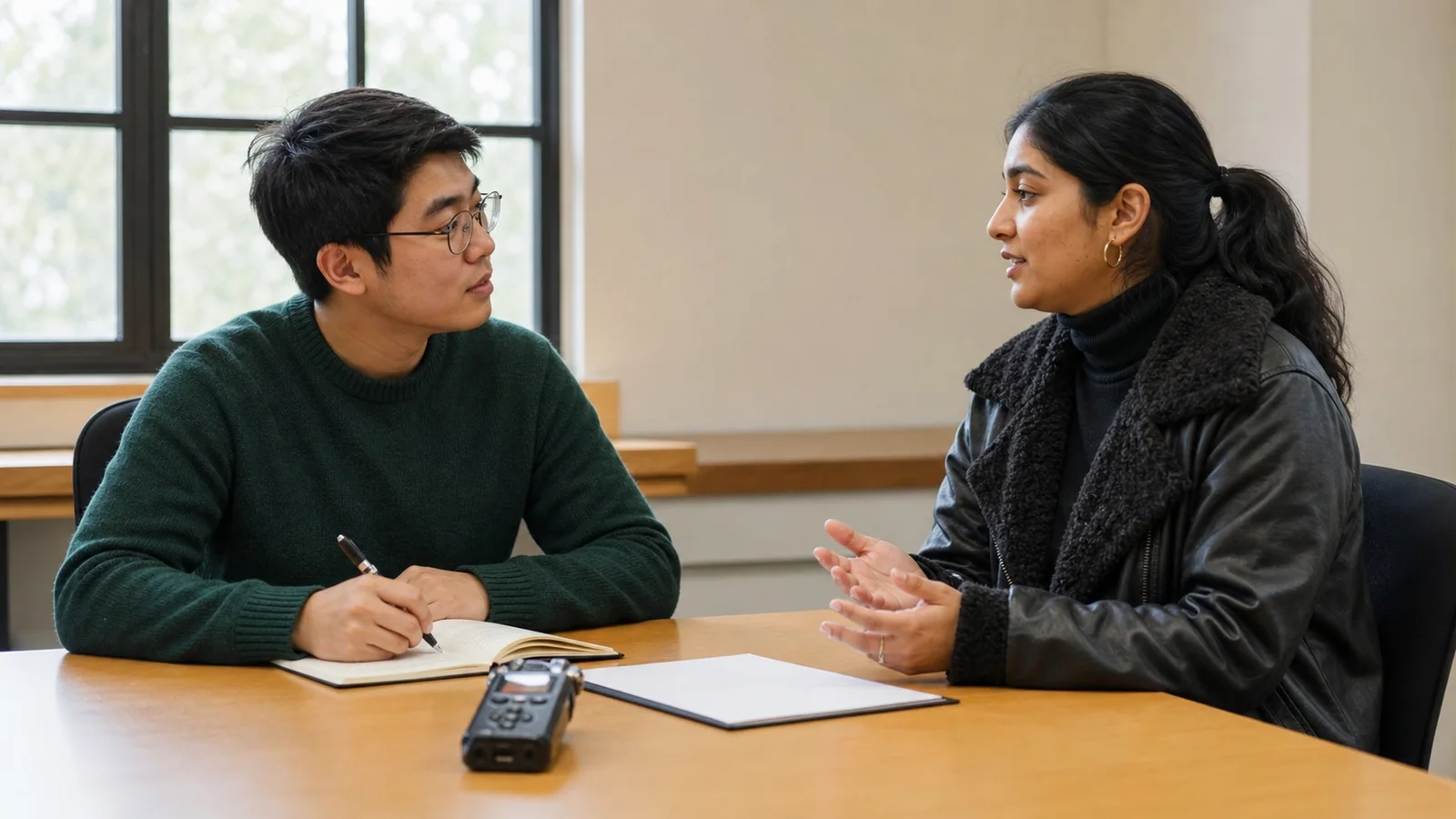
Research interviews can explore how people understand experiences, decisions and meanings in their own words. They require more than asking prepared questions: the researcher must manage consent, power, listening, follow-up, recording and interpretation responsibly.
Approval comes before recruitment or data collection where the institution requires it. The exact consent, safeguarding, recording and data-handling rules depend on the project, participants and location, so this guide cannot replace the university ethics process.
Plan the full route from invitation to secure deletion before the first session. Decisions made during recruitment and recording can determine what can later be transcribed, quoted, shared or retained.
Explain why interviews are appropriate
Connect the method to the research question. Interviews are suitable for detailed accounts and interpretations, but they do not directly observe behaviour or automatically represent a wider population.
Choose the interview format
Structured, semi-structured and less structured interviews offer different consistency and depth. Decide whether sessions will be individual or group-based, in person or remote, and justify the choice against the study aims and risks.
Secure ethics approval first
Submit the required protocol, information sheet, consent process, recruitment plan, prompts, recording approach and data-management details. Do not treat a practice interview as research data unless that use was approved and consented.
Define and recruit the sample
Set inclusion and exclusion criteria linked to the question. Use approved channels and avoid pressure. Explain incentives accurately and consider whether gatekeepers may influence who feels able to participate.
Prepare clear participant information
Describe the purpose, session, recording, voluntary nature, risks, withdrawal limits, data access and contact routes in understandable language. Give people suitable time to decide and an opportunity to ask questions.
Build an interview guide
Organise a manageable sequence of open prompts around the research objectives. Start with accessible context, move to central topics and close with an opportunity to add or clarify information. The guide is a route, not a script to read mechanically.
Write neutral questions
Ask one idea at a time and avoid wording that assumes a preferred experience. Replace “Why was the service difficult?” with a prompt that allows positive, negative or mixed accounts. Use technical terms only when the participant understands them.
Prepare useful probes
Prompts such as “Can you give an example?” or “What happened next?” invite detail without supplying an answer. Plan probes for important topics, then use them responsively rather than interrupting every account.
Pilot the complete process
Test timing, question order, recording, remote links and file transfer with an appropriate practice participant. Notice where prompts confuse or duplicate. Update approved materials through the required process when changes are material.
Create a safe interview setting
Choose a private, accessible environment and confirm who is present. For remote sessions, discuss privacy at both ends and what will happen if the connection fails. Follow lone-working or safeguarding requirements where applicable.
Listen and manage the pace
Allow pauses, ask for clarification and keep your reactions neutral enough not to steer the response. Monitor time without rushing important material. The participant is not responsible for filling every silence.
Respond to distress or disclosure
Use the approved protocol rather than improvising a promise or investigation. Remind participants they may pause or stop, follow safeguarding duties and record only what the study is permitted to retain.
Close and debrief properly
Ask whether the participant wants to add anything, explain the next steps and repeat relevant withdrawal or contact information. Check consent for any future quotation or reuse exactly as the approved process requires.
Transfer and document data securely
Move recordings and notes promptly to approved storage, use the required identifiers and restrict access. Keep a reflexive field note that distinguishes observed context from your interpretation. Delete temporary copies according to the plan.
Treat transcription as a research decision
Decide whether the analysis needs pauses, emphasis, non-verbal detail or a clean verbal transcript, and apply the convention consistently. Automated transcription may require approved processing and careful checking. Correct against the recording, record uncertain passages and remove identifiers according to the plan rather than assuming a transcript is anonymous.
Reflect on the interviewer’s role
Your identity, assumptions, tone and relationship to the topic can shape what is asked and what participants feel able to say. Keep reflexive notes after each session and examine patterns in probing or interpretation. Reflexivity does not remove influence; it makes relevant influence visible enough to consider during analysis and reporting.
Review the guide with an authorised adviser
Ask the supervisor or methods adviser to test whether each prompt addresses the research question and whether sensitive transitions are justified. Ethics reviewers assess participant protection, but they do not guarantee that an interview will produce analytically useful data. Method quality and ethical approval are connected responsibilities, not interchangeable approvals.
Final checklist
- The interview method and sample are justified by the research question.
- Ethics approval and informed consent are complete before data collection.
- Questions are clear, neutral and tested with the full process.
- Distress, disclosure, recording and remote-failure procedures are prepared.
- Recordings, notes and identities are handled under the approved plan.
Explore programmes available through Univs, compare listed institutes and read how the platform works. Research interviews must remain governed by the project’s approved university ethics and data-management requirements.
Editorial note
Requirements can change and may differ by institution, programme and applicant. Recheck current university and government guidance before paying or travelling.