

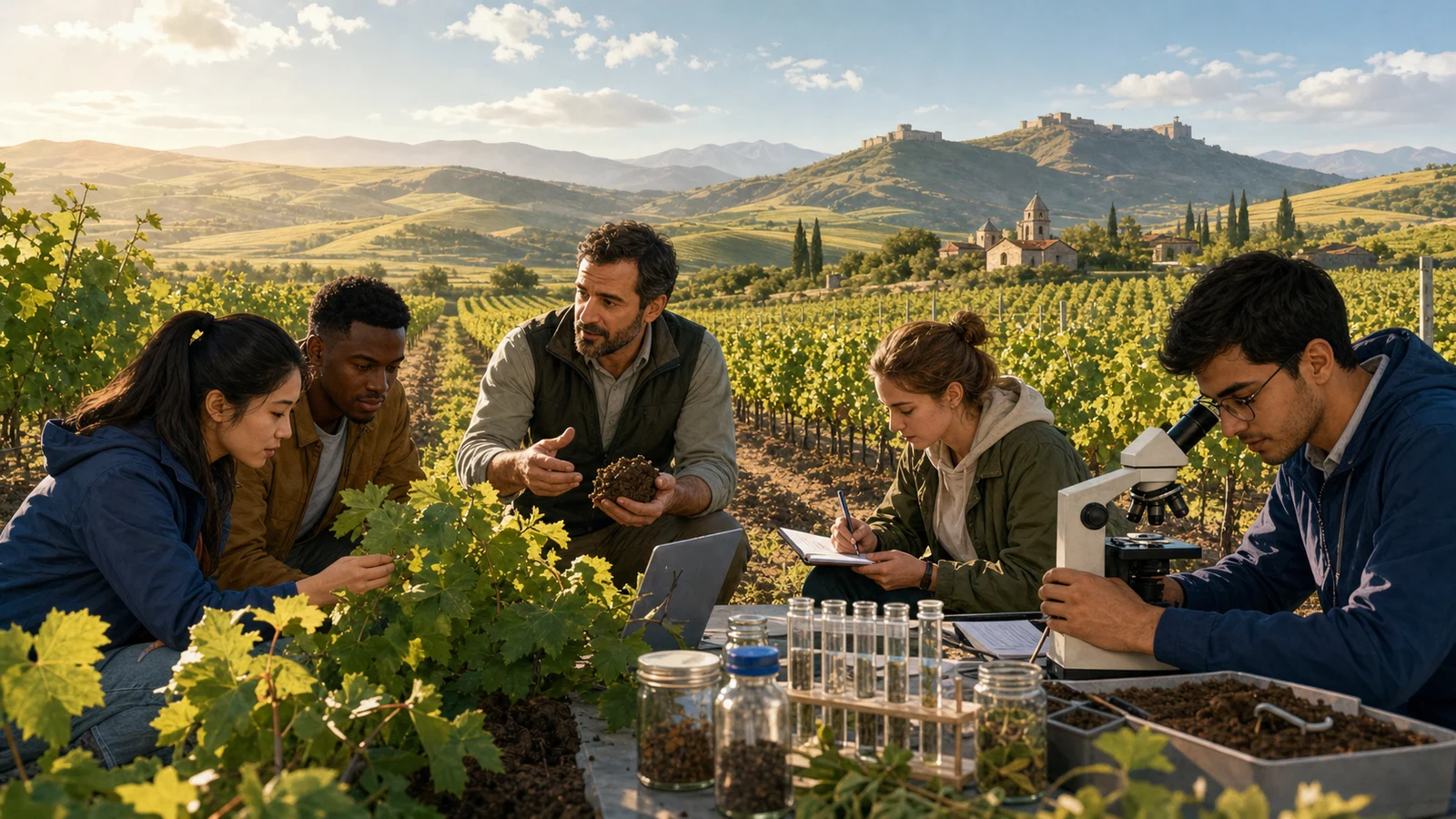
Georgia’s relationship with farming, grapes and wine makes Agriculture an intuitively relevant subject, but a good study decision still depends on the programme rather than the country’s reputation. The current Univs catalogue includes English-taught master’s routes in Agronomy and Viticulture and Enology at Georgian Technical University (GTU).
These are specialist postgraduate programmes. Applicants should compare scientific content, fieldwork, laboratory access, entry discipline and the recognition needed for their intended career.
What is the difference between Agronomy and Viticulture?
Agronomy examines crop production, soil, plant health, resource use and agricultural systems. Viticulture concentrates on grape cultivation, while enology covers the science and production processes associated with wine. Both can involve biology, chemistry, climate, data and practical field decisions.
Choose by the problems you want to work on. A broad interest in sustainable crop systems may fit Agronomy; a clear focus on vines and production may fit Viticulture and Enology.
Which programmes are currently listed?
The live catalogue currently shows Agronomy at Georgian Technical University and Viticulture and Enology at GTU. Both are listed at master’s level with a two-year duration.
That is a focused selection at one institution. Confirm the current intake and application route through the live Univs catalogue.
What should the scientific curriculum contain?
Depending on the route, look for plant physiology, soil science, crop management, pest and disease control, climate, statistics, laboratory methods and research design. Viticulture and Enology may add grape varieties, vineyard technology, fermentation science, quality control and production systems.
Request module descriptions if the public summary is broad. Ask how science, management and field practice are balanced.
Who can apply to these master’s programmes?
Postgraduate eligibility may depend on a bachelor’s degree in agriculture, biology, environmental science, food science, chemistry or another accepted field. Confirm the exact prerequisite subjects, English evidence, interview or examination and whether bridging study is available.
Submitting a bachelor’s diploma does not guarantee that its subject content satisfies the programme.
How important are fieldwork and laboratories?
They are central to many agricultural disciplines. Ask how much supervised field or laboratory activity is compulsory, where it takes place, how seasons affect scheduling and what students actually measure or produce. Confirm whether external placements are guaranteed, competitive or optional.
Students should also ask about safety training, protective equipment and any additional travel or material costs.
How should international students assess the language environment?
A programme may be taught in English while field partners, local documentation or day-to-day agricultural work use Georgian. Ask how this affects placements, research access and employment. Learning local terminology may be valuable even when the academic assessment is in English.
Location also matters. Ask how often teaching moves beyond the main campus, how students reach farms or vineyards, and whether field days can change with weather or growing conditions. International students should understand the practical timetable before arranging work, travel or accommodation.
What should you budget for?
Use the exact programme page for current tuition and application charges. Add accommodation, food, transport, health cover, travel and immigration-related costs where relevant. Field visits, laboratory clothing, specialist equipment, research materials or travel outside Tbilisi may be additional.
Request a realistic year-by-year estimate. Do not assume that every field activity or consumable is included in tuition.
Students planning a research thesis should also ask who pays for sampling, laboratory analysis, local travel and any specialist data collection.
What careers may follow?
Possible directions include crop production, vineyard management, laboratory or quality support, agricultural consulting, research, supply chains, food-production organisations or further study. Some technical roles require local certification, supervised experience or knowledge of local regulation. A degree does not guarantee employment or authority to sign professional reports.
What should you ask before applying?
Request the current module list, research themes and a realistic schedule of field and laboratory work. Ask whether the same facilities support both English and Georgian cohorts, how supervision works in the field and which seasons are important for practical activity. Confirm whether students arrange their own research sites.
For Viticulture and Enology, ask how cultivation science and production science are balanced. For Agronomy, ask which crops, soil conditions and technologies receive sustained attention. These details determine whether the programme fits your intended region or industry.
A practical comparison checklist
- Confirm that your bachelor’s subject satisfies the entry requirement.
- Compare plant, soil, climate, laboratory and research depth.
- Review the quantity and location of fieldwork.
- Ask about language needs outside the classroom.
- Calculate field, equipment and travel costs.
- Verify recognition for your intended country and role.
Is Agriculture or Viticulture study in Georgia a good option?
It may be for a suitably prepared graduate who wants applied postgraduate study in a country with a strong agricultural and wine context. The current English-taught Univs selection is limited to two GTU master’s routes, so examine the scientific and practical evidence closely. Explore Georgia’s study hub before applying.
Editorial note
Requirements can change and may differ by institution, programme and applicant. Recheck current university and government guidance before paying or travelling.
For comparisons, we assess the stated student brief, current route availability, discovery breadth, application ownership, progress visibility, support, costs and duplicate-application risk. Univs publishes this page and may have commercial relationships with institutions; those relationships do not determine admission decisions. Read our editorial standards.