

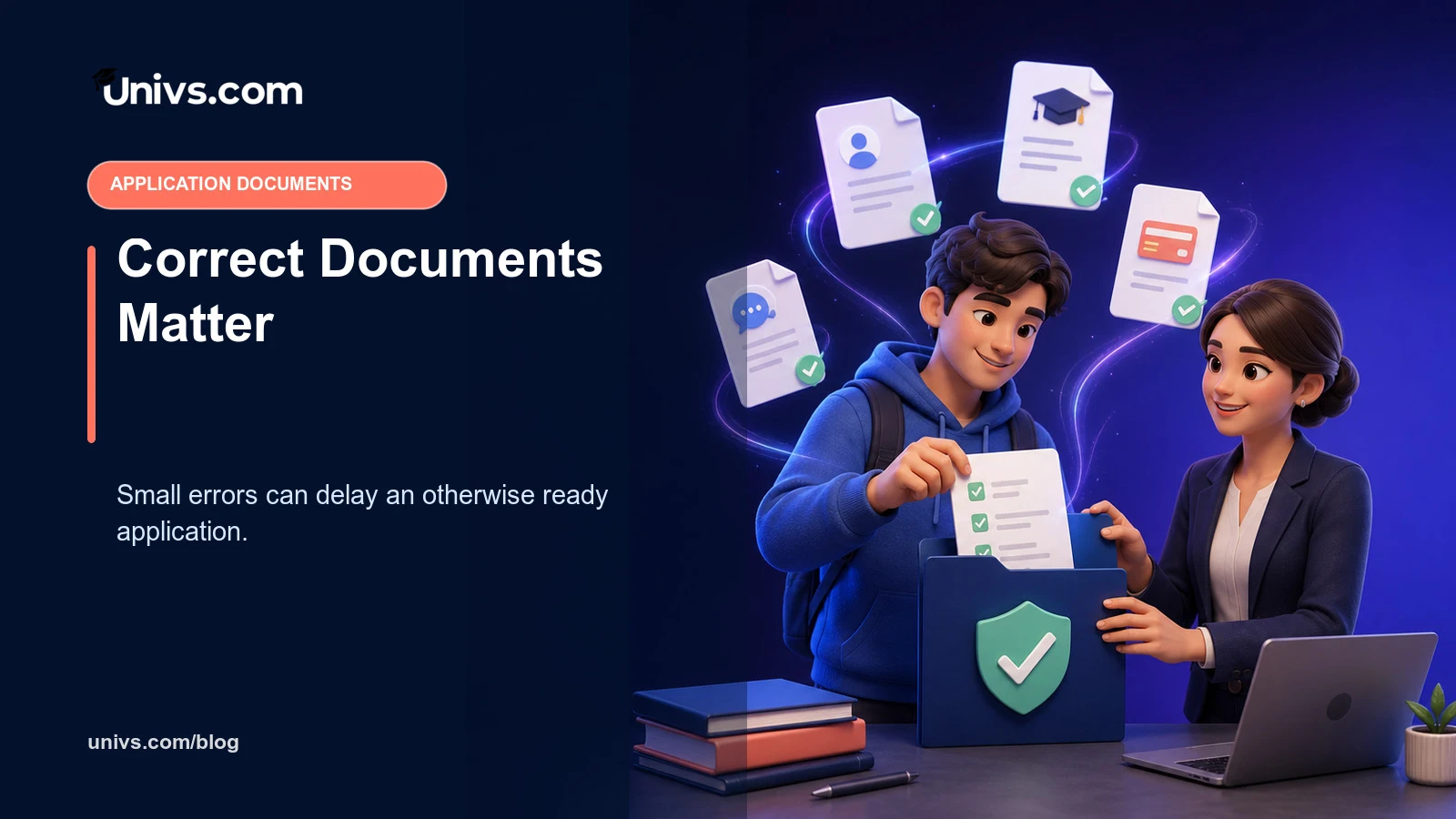
A university application is not assessed as a loose collection of files. Admissions staff compare the form, passport, academic records, language evidence, payment records and later correspondence as one file. A small difference can be harmless, but an unexplained contradiction can delay review or create doubt about which information is authoritative.
Correct documents do not guarantee admission. They make it possible for the university to assess the real applicant, the real qualification and the correct programme without avoidable clarification. The exact list always depends on the institution, programme, study level, citizenship and application route.
What “correct documents” actually means
A correct document is genuine, complete, readable, current where necessary and submitted in the form requested. Names, dates and qualification details should agree with the application. Every page that belongs to the record should be present. A file can be authentic and still be unusable if it is cropped, expired, mistranslated or uploaded under the wrong category.
Admissions teams need a consistent identity
Your passport normally provides the primary spelling of your legal name for an international application. Compare it with the form, certificate, transcript, language result and payment reference. If a historical record uses a different spelling or a previous name, do not silently edit it. Prepare the official explanation or supporting evidence the university requests.
Qualifications must match the study level
A bachelor’s application generally relies on completed secondary education; a master’s application relies on an eligible prior degree and its academic record. The document title varies by country, so the admissions team may need both the award certificate and transcript. Check the exact programme requirements in the current Univs programme catalogue before assuming one common list applies everywhere.
Completeness is different from sending everything
More files do not make an application stronger. Unrequested certificates can hide the important evidence, expose unnecessary personal data and create version confusion. Build a checklist from the current official instructions, then supply every required item once in the requested place. Keep optional evidence separate unless it directly supports a published criterion.
Why small contradictions cause delays
A different date of birth, inconsistent graduation year, missing transcript page or payment made under an unidentified name may require a manual check. The university cannot safely guess which version is right. A prompt, factual clarification is usually more useful than repeatedly uploading the same files or sending several urgent messages.
Never “fix” an official record yourself
Do not change a grade, date, stamp, signature, background, page number or identifying detail in an image editor. Cropping to remove unrelated margins can also remove evidence the reviewer needs. If the issuing authority made an error, ask it for a corrected record or follow the university’s written procedure for explaining the discrepancy.
Check format, translation and certification separately
A clear scan is not automatically a certified copy, and a translation is not automatically notarised or legalised. These terms describe different steps. Review the current Georgia study information, then confirm which step applies to your country and purpose before paying.
Use one controlled upload route
When an application is managed through Univs, use the student portal workflow. Label the file accurately and replace a document only when the route allows it. Sending another copy through unrelated email, chat and support channels can make it unclear which version should be reviewed.
What to do when you discover a mistake
Stop sending further versions. Record the affected document, the incorrect detail, the correct detail and whether the application was already submitted. Contact the responsible admissions channel, explain the error in one concise message and ask how to replace or annotate the record. Keep the reply with the corrected file.
Protect the original and the submitted copy
Store an untouched master copy in a secure location. Keep a separate submission folder containing exactly what was sent, the date, destination and confirmation. Avoid public file-sharing links and do not place passport numbers or health information in filenames. Access should be limited to people genuinely helping with the application.
Run a cross-document consistency review
Open the application form beside the passport, certificate, transcript and any language result. Read names, birth dates, institution names, qualification titles and completion dates line by line. Then compare the programme, intake and study level on the form with the offer or invoice. This review is different from proofreading a single document: it finds contradictions that appear only when two genuine records are placed together. Record any legitimate difference and obtain the correct explanation before submission instead of hoping the reviewer will infer it.
Questions to ask when a requirement is unclear
Ask which document type is acceptable, whether every page is required, which language and format to use, and whether the copy needs translation or certification. State the country that issued the document and the exact programme level, because those details may change the answer. Keep the written response with the checklist. A targeted question protects the application better than a broad request for somebody to “check everything” without the current instructions.
A five-minute final check
- Confirm the programme, intake and study level.
- Match names and dates against the passport.
- Open every file and inspect every page.
- Check translation, certification and format instructions.
- Save the submitted version and confirmation.
The practical standard
Follow the complete Georgia university application process and treat document accuracy as part of the application, not an administrative detail after it. The aim is a truthful, traceable file that another person can understand without guessing. When requirements conflict or remain unclear, ask before altering or resubmitting anything.
Editorial note
Requirements can change and may differ by institution, programme and applicant. Recheck current university and government guidance before paying or travelling.
For comparisons, we assess the stated student brief, current route availability, discovery breadth, application ownership, progress visibility, support, costs and duplicate-application risk. Univs publishes this page and may have commercial relationships with institutions; those relationships do not determine admission decisions. Read our editorial standards.