

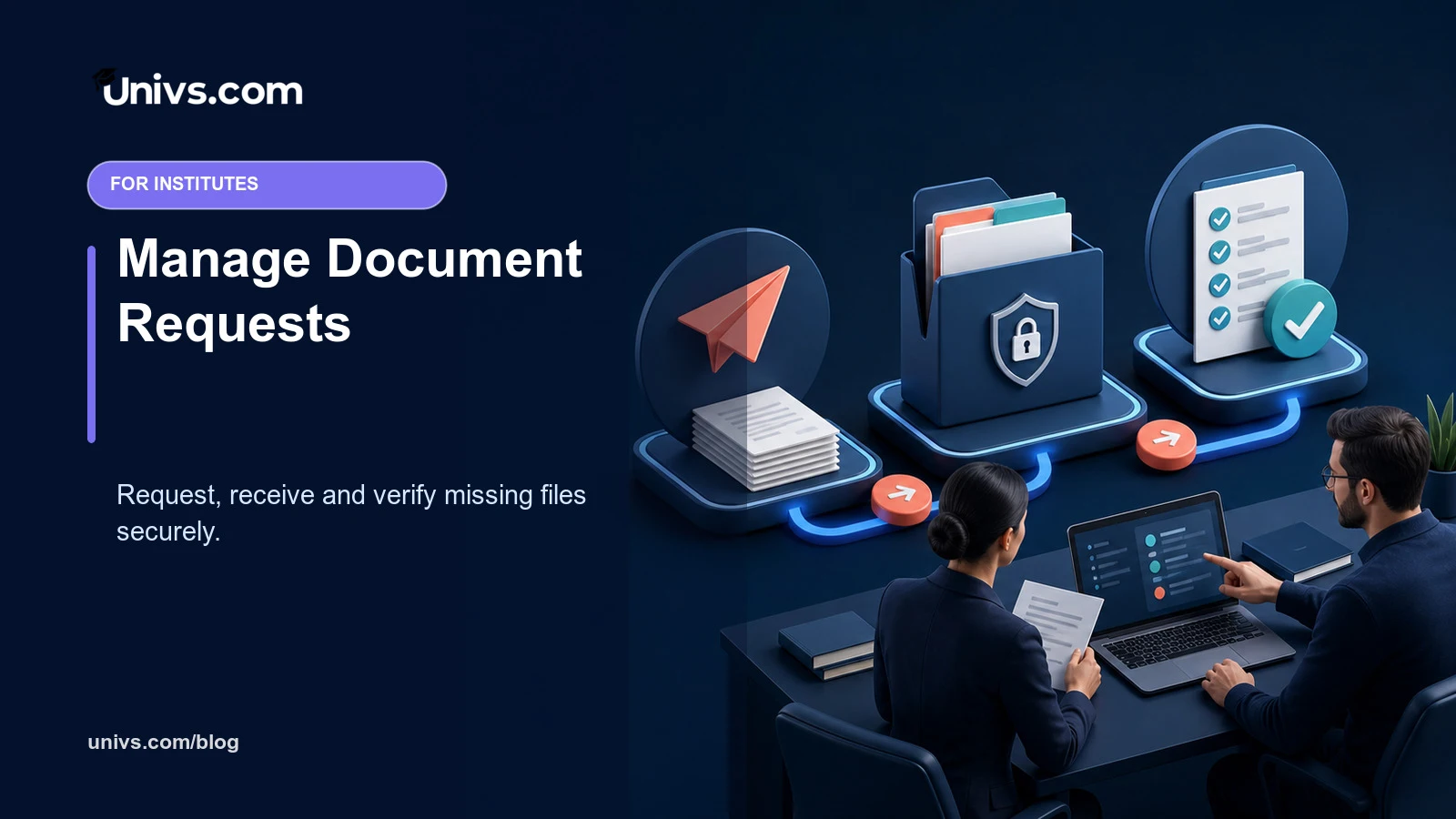
A missing or unreadable document should lead to a precise request, not a vague instruction to upload everything again. Repeated files create confusion for applicants and make it harder for reviewers to identify the current evidence.
The Univs institute workflow can connect a document request to the application and track whether a replacement is awaited, pending review or accepted within the process. Staff can see the request beside the case rather than reconstructing it from unrelated email.
A status on a document is not a decision on the application. The institute still needs to assess authenticity, relevance and academic sufficiency.
The short answer
Univs helps institutes manage application document requests by linking each request, replacement and review state to the correct case. The workflow can reduce duplicate requests and missing context while keeping evidence assessment and admission responsibility with the institute.
How the benefit works
| Institute need | Useful Univs role |
|---|---|
| Identify the problem | Name the missing, unreadable or unsuitable evidence precisely |
| Request safely | Use the protected route connected to the application |
| Track replacement state | Distinguish awaiting upload, pending review and reviewed items |
| Preserve the case history | Keep the request and response in the application timeline |
Request the evidence, not a broad category
A phrase such as academic documents may include several unrelated files. Staff should name the exact item, the problem and the acceptable replacement. A focused request reduces unnecessary disclosure and gives the applicant a realistic chance to respond correctly the first time.
Explain why the document is needed
Identity, prior education, language evidence and programme-specific material support different decisions. Connecting the request to its purpose helps reviewers apply the right standard and prevents the applicant from assuming that upload alone proves eligibility or acceptance.
Use the application-linked upload route
Sensitive evidence should stay inside the protected workflow associated with the correct application. Staff should not direct applicants to personal inboxes, public forms or unrelated chats. The institute must verify the recipient and route before asking for a passport, transcript or other confidential record.
Replacement states prevent repeated chasing
Awaiting upload, pending review and accepted are operationally different. A visible state helps teams avoid sending another reminder after the applicant has already responded. Staff should still check the latest file and not treat a system status as proof that the content is valid.
Keep earlier versions for traceability
Where policy permits, a version history can show what changed and why a replacement was requested. Reviewers should use the current approved evidence while retaining only the history needed for audit and resolution. Retention, access and deletion must follow institutional and legal requirements.
Separate file quality from academic judgement
A clear scan can pass a readability check but fail an academic requirement. Conversely, a difficult file may contain valid evidence that needs a better copy. Document workflow should make those questions visible instead of compressing them into one approved or rejected label.
Protect the minimum necessary data
Institutes should request only the pages and fields needed for the defined purpose. Staff access should be limited by role, and exported or downloaded documents require careful handling. A convenient platform does not justify collecting extra personal or health information without a valid reason.
Review patterns without exposing applicants
Aggregate counts of common missing items can show where instructions need improvement. Reports should not include student identities unless the operational task genuinely requires them. If many applicants submit the wrong evidence, the first response should be to inspect the requirement wording and form design.
How institute teams should use this well
Build a controlled document-request catalogue with a name, purpose, accepted format and responsible reviewer for each item. Train staff to select the smallest relevant request, include a clear deadline and use the application-linked route. Audit duplicate and unresolved requests using aggregate evidence.
What still belongs to the institution
The institution decides which documents are required, whether a replacement is acceptable, how long evidence is retained and whether the academic condition is met. Univs can organise secure requests and statuses, but it cannot authenticate every file, determine equivalency or convert document completion into admission.
Questions to ask during onboarding
- What exact evidence is missing or unsuitable?
- Why is it needed for this programme?
- Is the protected application route being used?
- Who will review the replacement and update its state?
- What data can be avoided or removed under the retention policy?
A practical next step
Review the ten most common document requests and rewrite any broad item as a precise instruction with purpose, accepted format and owner. Test the replacement journey with a fictional file, including a second correction, so staff can see which version is current.
Final perspective
Univs helps institutes turn document chasing into a traceable part of the application. The gain is clearer evidence handling with less repetition, provided the institution keeps requests precise, access limited and academic judgement separate from upload status.
Continue with the institute partnership page, the Univs trust approach, the student application process and the programme context for requirements.
Editorial note
Requirements can change and may differ by institution, programme and applicant. Recheck current university and government guidance before paying or travelling.