

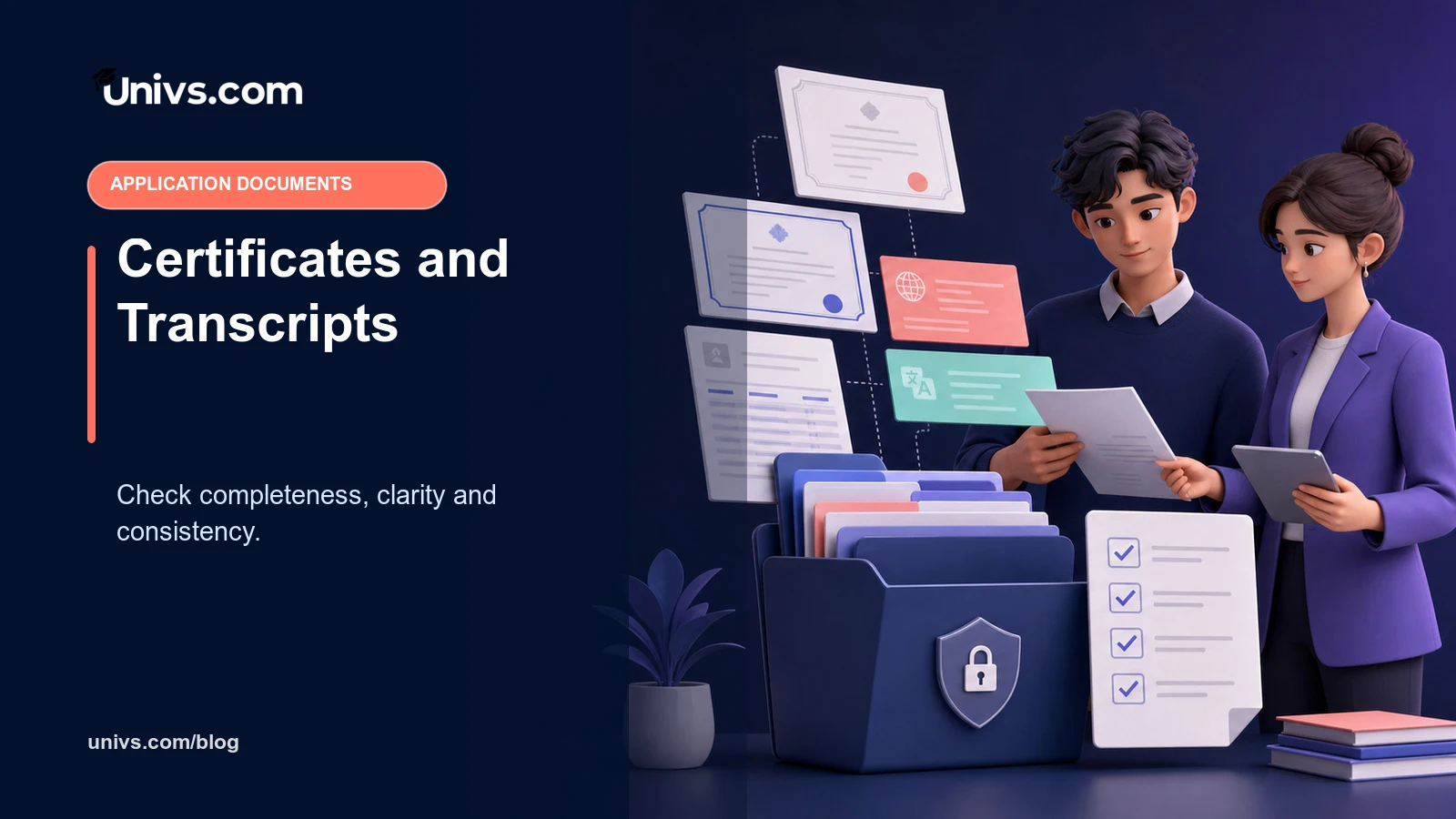
Certificates and transcripts answer different admissions questions. The certificate normally shows that a qualification was awarded; the transcript shows the subjects, grades, credits or study history behind it. Many applications need both, even when students casually call them the same “school document”.
This checklist is for preparation, not recognition advice. Institutions can require different evidence for undergraduate, postgraduate, transfer and regulated programmes. Use the current instructions for the exact programme and intake.
Identify the qualification being assessed
Start with the entry level. An undergraduate application may require a school-leaving certificate and grade record. A master’s application may require the bachelor’s diploma and transcript. A transfer application can require a current transcript, completed-credit information and course descriptions. Do not substitute a lower or unrelated award because it is easier to scan.
Understand certificate versus transcript
The final certificate confirms the award, institution and completion. The transcript normally lists modules or subjects and results. A provisional statement, marksheet, expected-graduation letter and final diploma can each serve different purposes. If the final award has not been issued, ask whether provisional evidence is accepted and when the final record must follow.
Check every page before scanning
Count the pages, including reverse sides that contain stamps, grading keys or notes. Confirm that names, dates, institution details and qualification titles are visible. A missing page can make a complete qualification look incomplete. Do not rearrange the official sequence simply to create a shorter PDF.
Keep the grading scale and explanatory notes
A number or letter only has meaning within its grading system. Include the official scale, maximum mark, credit explanation or legend when it forms part of the transcript. Do not create your own grade conversion unless the receiving institution specifically requests one and tells you which method to use.
Match the award to the application form
Copy the official institution name, qualification title and dates carefully. Do not translate a title informally in one place and differently in another. If the application asks for an English description, keep the original title and use the certified translation or official English version where available.
Distinguish final, provisional and predicted results
Label the status truthfully. Predicted grades are not final results, and a statement of completion is not always the diploma. Admissions teams may issue a conditional decision and later require final evidence. Record the deadline and method for providing the final version rather than assuming the earlier file closes the requirement.
Translations must stay connected to the source
Keep the original-language document and its translation together in the order requested. Page numbers, stamps and names should be traceable between them. The current Georgia study guide provides destination context, but translation, notarisation and legalisation must still be confirmed as separate checks.
Transfer applicants need more detail
A receiving university may assess completed subjects, credits, hours and syllabus content, not only the overall result. Prepare current transcripts and any officially requested course descriptions. Credit transfer is an academic decision; a similar module title does not guarantee that credit will be accepted.
Use readable, faithful digital copies
Scan in colour where colour carries official information, keep all edges visible and check small stamps at normal zoom. Follow the file type and naming rule stated by the institution. The Univs student portal guide explains how documents remain connected to the application record.
What if the document contains an error?
Contact the issuing school, examination board or university. Do not edit the image or cover the incorrect entry. If a corrected record cannot be issued immediately, ask the destination what official explanation it accepts. Keep the request and response with the application record.
Build a page-by-page inventory
Create a private list showing the document title, issuer, issue date, number of pages, language and whether a translation accompanies it. For a transcript, note whether the grading key and final result appear. For a provisional record, note when the final version is expected. This inventory is not submitted unless requested; it is a control sheet that helps the student notice a missing reverse side, duplicated page or certificate that belongs to a different qualification.
Recheck after combining or converting files
Combining images into a PDF can change page order, orientation or quality. Open the final file from beginning to end and compare it with the inventory. Confirm that text remains searchable only if the conversion produced it faithfully; automatic optical character recognition can misread names and marks. The visible official page remains the evidence. If the destination asks for separate files, do not combine them simply because one PDF is easier to store.
Academic-document checklist
- Correct qualification for the chosen level.
- Certificate and transcript where both are required.
- All pages, reverse sides and grading keys.
- Final or provisional status labelled accurately.
- Original, translation and certification matched correctly.
Choose the programme before finalising the pack
Compare the programme level and entry context in the Univs programme catalogue, then review how the complete application process works. A careful academic record makes assessment possible; it does not promise admission, recognition or credit transfer.
Editorial note
Requirements can change and may differ by institution, programme and applicant. Recheck current university and government guidance before paying or travelling.
For comparisons, we assess the stated student brief, current route availability, discovery breadth, application ownership, progress visibility, support, costs and duplicate-application risk. Univs publishes this page and may have commercial relationships with institutions; those relationships do not determine admission decisions. Read our editorial standards.