

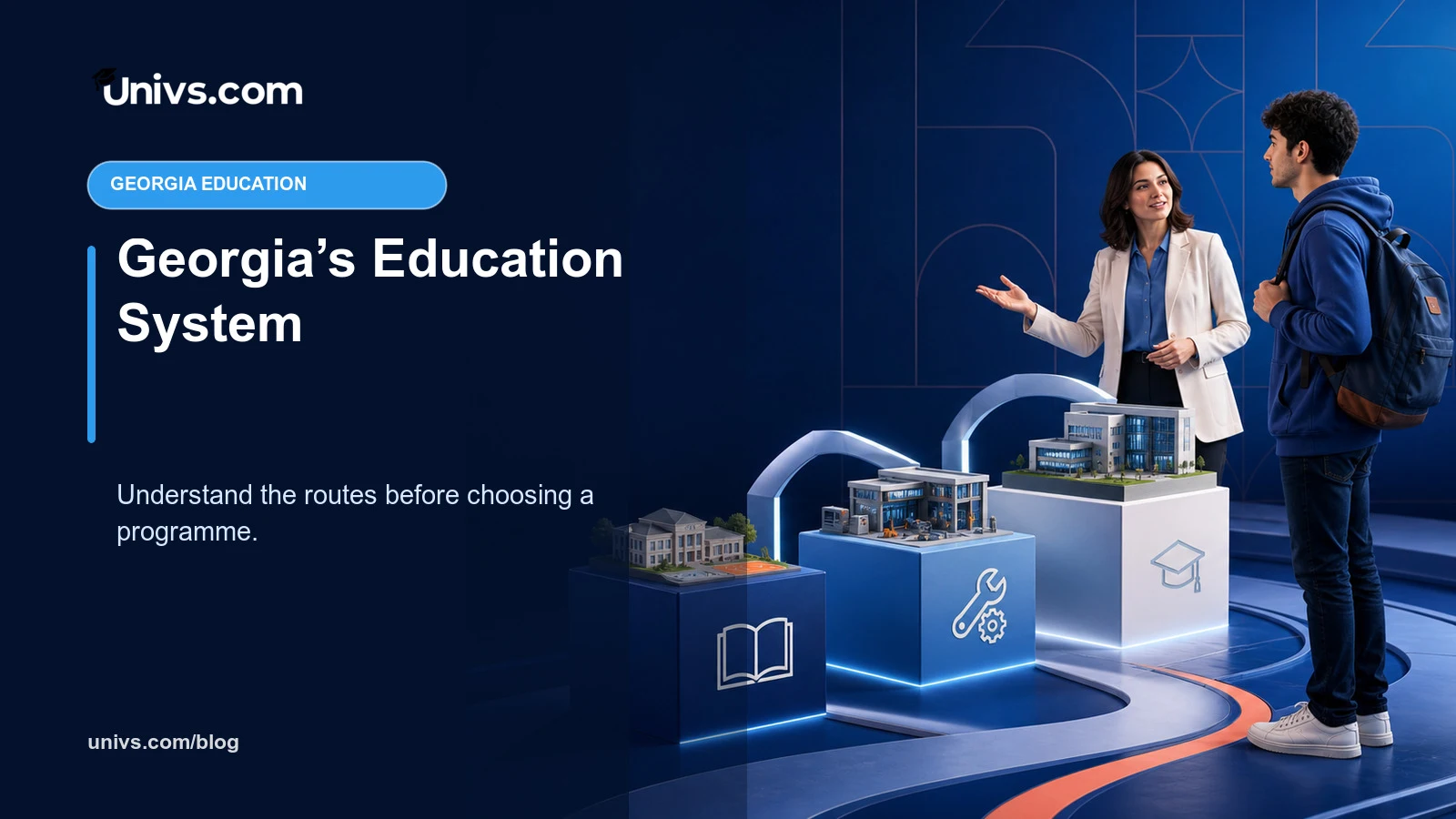
Georgia has general education, vocational education and higher education routes. For an international applicant, the important question is not simply whether a provider calls itself a university or college. It is whether the institution is authorised, whether the exact programme has the required status and what qualification the route is designed to award.
Higher education is organised around Bachelor’s, Master’s and doctoral levels, while some regulated or integrated programmes follow their own structures. Vocational routes use different qualification levels and may emphasise occupational competence more directly.
This guide explains the system as a decision map. It does not replace the current rules of a university, the National Center for Educational Quality Enhancement or the authority that will later assess the qualification in another country.
The short answer
Georgia’s education system gives students several routes: general education prepares learners for further study, vocational education develops occupation-focused competence and higher education leads to academic qualifications. International students should verify the institution, the exact programme, its qualification level, teaching language and progression route separately.
What to understand at a glance
| Question | Practical answer |
|---|---|
| What are the main pathways? | General, vocational and higher education operate as related but distinct sectors |
| How is higher education organised? | Bachelor’s, Master’s and doctoral study form the main academic levels |
| Does the provider name prove recognition? | No; check institutional authorisation and the exact programme status |
| Can one route automatically replace another? | No; admission, credit recognition and progression require a separate decision |
General education is the usual foundation
Completion of recognised general education is normally the starting academic evidence for first-cycle university entry. International applicants may follow a different admissions procedure from Georgian school-leavers, but their prior education still has to be documented and accepted. A school certificate is therefore not merely an upload: its level, authenticity, translation and relationship to the chosen programme can matter.
Vocational education has a different purpose
Vocational programmes are designed around occupational learning outcomes and may sit at several levels of the Georgian qualifications framework. They can be an appropriate choice for practical career preparation, but they should not be described as a Bachelor’s degree unless the formal award actually is one. Students need to compare the awarded qualification, progression options, practical content and authorised provider.
Higher education is programme-led
A university name does not tell a student everything about the education offered. The award, curriculum, credits, duration, teaching language and admission conditions belong to the specific programme. Two programmes at the same institution can lead to different levels and professional possibilities, so the programme record should remain central throughout research and application.
Institution and programme checks answer different questions
Institutional authorisation assesses whether a higher education institution may operate and issue state-recognised diplomas. Programme accreditation examines the programme against applicable standards. Students should not treat one check as a substitute for the other, particularly in regulated fields or where a destination-country professional body will make its own decision.
Qualification levels describe learning outcomes
The National Qualifications Framework connects awards to expected knowledge, skills, responsibility and autonomy. A level is more informative than a marketing phrase such as advanced or professional. It helps explain the academic position of an award, but it does not by itself guarantee admission to a later programme, employment or licensing abroad.
Credits describe workload rather than classroom hours alone
Georgian higher education uses ECTS when programmes are developed and delivered. A typical academic year is associated with about 60 credits, but the work behind those credits may include lectures, seminars, practical tasks, assessment and independent study. Students should read the curriculum rather than assume every credit represents the same timetable.
International admission is a separate route
Foreign applicants may be eligible to apply under procedures that differ from the route used by local entrants. That does not remove institutional admission criteria or document checks. The university, relevant Georgian authorities and any later professional regulator have different responsibilities, and a positive decision from one does not automatically decide the others.
The strongest comparison joins system and programme evidence
A useful shortlist connects the education system to a real programme: authorised institution, current programme status, recognised award, appropriate level, clear curriculum, accurate fees and an operational application route. This prevents broad claims about studying in Georgia from replacing the evidence needed for one student’s decision.
How to use this information well
Start with the qualification you need, then work backwards. Identify the appropriate level and field, find current programmes, check the institution and programme status, and read the award and curriculum carefully. Keep source dates beside every consequential fact and ask for clarification when the public record and admissions message do not agree.
What can vary by institution or programme
Programme availability, entry rules, academic calendars, teaching methods, fees and progression arrangements vary. Regulated professions can require additional recognition or licensing outside the university. This overview should therefore organise questions, not be treated as a universal admissions or professional-recognition decision.
Questions to ask before you decide
- What formal qualification will the programme award?
- Which framework level and credit total apply?
- Is the institution authorised and the programme appropriately accredited?
- How does the route admit international applicants?
- Who will decide recognition after graduation in the intended destination?
A practical next step
Create a one-page pathway for your intended career: present qualification, proposed Georgian programme, awarded degree and planned next step. Add the responsible decision-maker beside each transition. If a transition depends on an assumption, verify it before paying or submitting irreplaceable documents.
Final perspective
Georgia’s education system is easier to understand when each layer is kept distinct. Institution, programme, qualification, admission and later recognition are connected, but none automatically proves the others. A careful student follows that chain instead of relying on one broad promise.
Continue with the Univs guide to studying in Georgia, current programmes in the Univs catalogue, institutions currently listed on Univs and how the Univs application journey works.
Official resources
Editorial note
Requirements can change and may differ by institution, programme and applicant. Recheck current university and government guidance before paying or travelling.
For comparisons, we assess the stated student brief, current route availability, discovery breadth, application ownership, progress visibility, support, costs and duplicate-application risk. Univs publishes this page and may have commercial relationships with institutions; those relationships do not determine admission decisions. Read our editorial standards.