

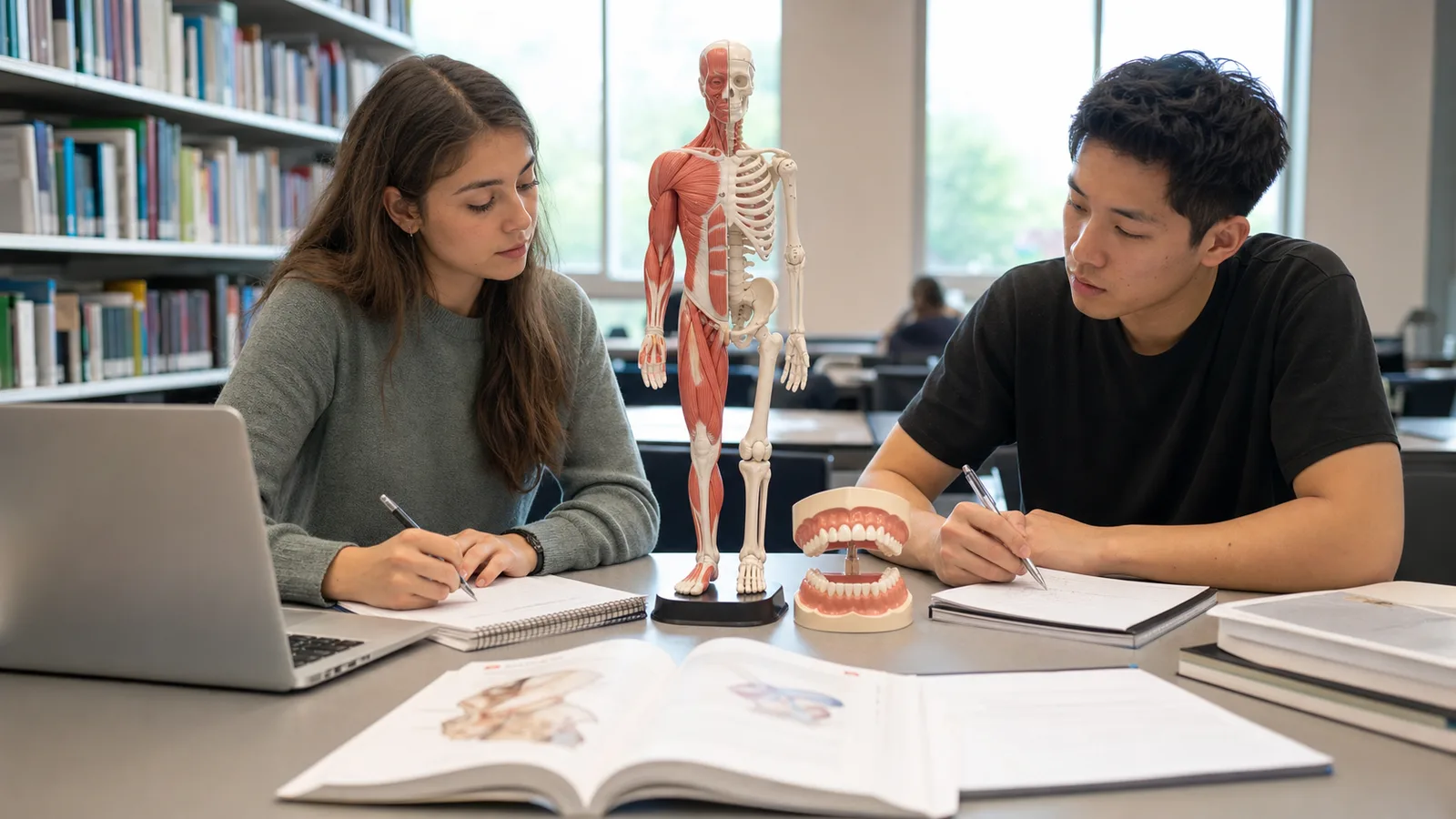
Medicine and dentistry share a scientific foundation, clinical responsibility and direct patient contact, but they organise that responsibility differently. Medicine prepares students to understand health across body systems and care settings. Dentistry concentrates on oral health while demanding very precise practical work in a smaller anatomical field.
The better programme is the one whose curriculum, clinical environment and professional route fit you. Do not decide from prestige, salary stories or the idea that dentistry is simply a shorter version of medicine. Both are regulated professions, and an international qualification must be checked against the rules of the country where you hope to practise.
The shortest useful answer
Choose medicine if you want broad responsibility for diagnosis and treatment across body systems and can accept a long, varied clinical pathway. Choose dentistry if you want oral-health practice, close procedural work and sustained development of fine manual skills. This is a question of professional focus, not status.
Where the programmes overlap
Both routes normally include anatomy, physiology, pathology, pharmacology, communication, ethics, infection control and supervised clinical learning. Students in either field need scientific reasoning and the ability to work calmly with people who may be anxious or unwell. The overlap is real, but it does not make the professional roles interchangeable.
What medicine studies in greater breadth
A medical curriculum follows health and disease across multiple systems, age groups and specialties. Clinical rotations may expose students to medicine, surgery, paediatrics, mental health, community care and other settings. The exact sequence varies, so compare the current rotation plan rather than assuming every Medical Doctor programme offers the same experience.
What dentistry studies in greater depth
Dentistry moves from biomedical foundations into oral diagnosis, prevention, restorative work, periodontology, prosthodontics and other dental disciplines. Students develop procedural accuracy in confined spaces and learn how oral health connects with general health. Review how simulated practice progresses into supervised patient care.
Compare practical training, not only modules
Ask when students begin simulation, observation and patient-facing activity. In dentistry, check access to phantom-head laboratories, clinical chairs and the range of supervised cases. In medicine, examine teaching hospitals, rotation breadth, supervision and how practical competence is assessed. A long placement list is not enough without clear student responsibility and feedback.
Think honestly about manual precision
Dentistry requires repeated fine-motor practice, close visual attention and comfort working in a small field. Medicine also includes procedures, but the balance depends on later specialty and placement. If you enjoy practical work, test what kind: detailed hand skills in a consistent anatomical area are different from broader examination and clinical decision-making.
Compare the patient relationship
Doctors may manage acute illness, chronic conditions, prevention and uncertainty across many services. Dentists often combine prevention, diagnosis and planned procedures with continuing oral-health relationships. Neither route guarantees a particular timetable or lifestyle. Ask what kinds of conversations, follow-up and responsibility you would find meaningful.
Assessment can feel very different
Both programmes may use written examinations, practical tests and observed clinical assessments. Dentistry can add detailed evaluation of technical work and clinical requirements. Medicine may test reasoning across broad presentations and several rotations. Request the current assessment map and progression rules, including what happens when a required clinical competency is not completed.
Do not compare duration in isolation
The current Univs catalogue lists Georgian Medical Doctor routes as six-year programmes and Doctor of Dental Medicine routes as five-year programmes, but graduation is not the same as unrestricted practice everywhere. Internship, licensing, language, registration or postgraduate training may follow. Verify the complete route for your intended destination before using one year as the deciding factor.
Recognition must be destination-specific
Ask the relevant regulator whether the exact institution, programme, award and graduation year are acceptable. Requirements can involve document verification, examinations, supervised practice or additional training. A university being authorised in Georgia does not automatically confirm eligibility in another country, and an adviser should not promise that it does.
Compare the total learning environment
Review class size, laboratories, clinical partners, academic support, language preparation, attendance rules and access to real feedback. For dentistry, equipment and patient-case availability matter. For medicine, rotation coordination and teaching across sites matter. Use written evidence rather than a campus tour or a single student story.
Questions to ask yourself
Would you rather investigate health across the whole body or become deeply skilled in oral health? Do you prefer varied clinical settings or a more procedure-centred field? Are you prepared for the manual demands of dentistry or the broad uncertainty of medicine? Write evidence for your answers instead of choosing the identity that sounds more impressive.
A sensible decision test
Read the current curricula side by side and choose three modules and three practical experiences from each that genuinely interest you. Then research the professional route in your intended country. If your preference disappears when salary, family expectation and social status are removed, you may need more observation and structured career guidance.
Common comparison mistakes
Do not call dentistry easier medicine, assume every doctor works in hospital, or treat every dentist as a clinic owner. Avoid using social-media schedules as evidence. Most importantly, do not apply to both with the same motivation statement; the academic focus, practical work and professional responsibilities require different reasons.
Final comparison checklist
- I compared the current curriculum and clinical sequence for each exact programme.
- I understand the difference between broad medical care and oral-health practice.
- I considered manual work, patient contact, assessment and uncertainty honestly.
- I checked the complete recognition route for the country where I may practise.
- My choice is based on evidence rather than prestige, salary or family pressure.
Read the Medicine study guide, compare it with the Dentistry study guide and confirm current options in the Univs programme catalogue. Programme and professional requirements can change, so recheck the exact route before applying.
Editorial note
Requirements can change and may differ by institution, programme and applicant. Recheck current university and government guidance before paying or travelling.