
Health Insurance
Maintain valid health insurance for the full stay. EU/EEA students may use an EHIC where applicable; non-EU students need coverage meeting Bulgarian legal and visa requirements.


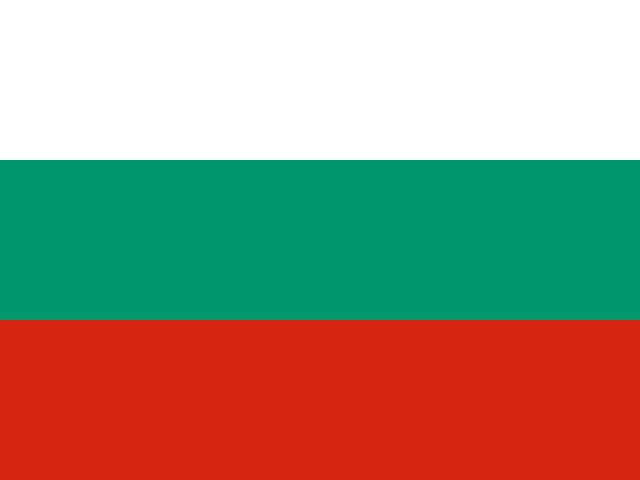
Compare Bulgarian higher-education institutions, English-taught programmes, tuition fees, admission requirements, scholarships, visa guidance and student life. Use verified institution records and programme-level evidence before applying or paying.
Study in a Bologna-system country using ECTS. The structure supports clearer comparison of workloads and can help academic mobility, while final recognition remains subject to the receiving institution or regulator.
English-taught bachelor’s and master’s programmes are available for international students across multiple fields. Confirm the exact teaching language, clinical-language requirements and entry standard for the chosen programme.
The European Education Area’s current Bulgaria profile gives general annual tuition ranges of €562–€5,360 for bachelor’s programmes and €1,945–€5,360 for master’s programmes, with typical living costs of €500–€900 per month.
Compare 38 public/state and 13 private institutions in the active national register, including comprehensive universities, specialist academies and independent colleges.
Eligible non-EU students can work up to 20 hours per week during the academic year and during official holidays without a separate work permit, subject to the current student-residence rules.
Choose a large capital-city environment in Sofia, established university communities in Plovdiv and Veliko Tarnovo, Black Sea study in Varna, or other regional centres with different academic strengths and living patterns.
EUR 500–900 per month, excluding tuition
EU, EEA and Swiss students do not need a student visa, but may need to register their residence for a stay longer than three months and must maintain the applicable student, insurance and resource conditions.
Prepare the passport and application, admission evidence, accommodation, valid health insurance, sufficient funds, medical evidence, photograph and any supporting documents required by the responsible Bulgarian mission. A Type D application requires a personal interview.
Up to 35 working days
Standard long-stay visa fee: €100 under Article 15(1), unless an exemption or different legal ground applies
Maintain valid health insurance for the full stay. EU/EEA students may use an EHIC where applicable; non-EU students need coverage meeting Bulgarian legal and visa requirements.
A non-EU graduate may have up to nine months to seek and start work and use employment services if the required Employment Agency registration is submitted within seven business days. A work and residence route is still required for continuing employment.
Bulgaria is currently assessed by the U.S. State Department at Level 1: exercise normal precautions. Students should still protect belongings, use licensed transport, avoid demonstrations, follow local instructions and review current travel advice.
Capital and largest university hub Comprehensive, medical, technical, economic, arts and security institutions Broadest choice Metro, tram, bus and rail connections
Large historic and cultural city Comprehensive, agricultural, medical, food-technology, arts and security-focused institutions Often considered below Sofia for rent, but prices vary Urban transport and intercity rail/bus
Black Sea university city Medical, economics, management, maritime, naval and technical study Seasonal coastal demand can affect rentals Urban transport, rail, bus and airport
Historic central Bulgarian university city Humanities, languages, education and defence-related study Smaller-city environment Bus and regional transport
South-western student city Public comprehensive and private liberal-arts education Compact student environment Bus links and local transit
Danube city near Romania Engineering, transport, technology, business and applied fields Regional-city cost pattern Road, rail and Danube connections
A passport, relevant prior degree, transcript, application form and language evidence are normally required. The institution may add subject prerequisites, entrance assessment, portfolio, references or a motivation statement.
A relevant master’s qualification, academic records, research proposal or topic fit, language evidence and supervisor or faculty requirements may apply.
A passport, secondary-school diploma, grade transcript, application form and proof of the required Bulgarian or English level are commonly requested. A medical certificate and programme-specific subject, exam or interview evidence may also be required.
Obtain the exact checklist, legalisation route, translation rules, deadline, fee schedule and refund terms in writing before paying. Admission, visa and professional-recognition decisions are separate.
Shortlist the degree level, subject, language and city that fit the student’s goals and prior qualification.
Confirm the institution’s current legal name and active entry in the NACID Register of Higher Education Institutions.
Check the latest NEAA institutional and programme decision and any licensing rules in the country where the graduate intends to work.
Request the current intake, deadline, teaching language, tuition, additional fees, entry tests and document checklist.
Collect the passport, qualification, transcripts, application, language evidence, medical certificate and programme-specific supporting records.
Complete the apostille or consular legalisation and Bulgarian translation route required for the issuing country and institution.
Apply through the institution’s approved international admissions route and keep the receipt and submission record.
Attend any language exam, interview, entrance test, portfolio review or subject assessment required by the programme.
Check the legal institution name, programme, tuition, payment schedule, refund rules and remaining conditions on the written offer.
Bulgaria combines a Bologna/ECTS higher-education system, English-taught options, 51 active institutions and comparatively moderate official tuition and living-cost ranges. Students should still compare the exact programme, accreditation, language, total cost and recognition outcome.
The active NACID register returned 51 institutions when checked on 9 August 2026: 38 public/state and 13 private.
Both. The current register dataset contains public/state universities and academies as well as private universities, specialised schools and independent colleges.
Yes. The European Education Area states that English-taught bachelor’s and master’s programmes are available for foreign students. Availability and language standards are programme-specific.
Bulgarian is the official language. Even on an English-taught degree, basic Bulgarian can help with daily life and may be important in clinical, school or community placements.
Bulgaria uses the euro. It joined the euro area and adopted the euro on 1 January 2026. The Bulgarian lev is no longer the current national currency.
The current European Education Area country profile gives a general range of €562–€5,360 per year. The exact fee may be higher or lower for a specific legal category or specialist programme, so confirm the university’s written fee for the intake.
The current general range is €1,945–€5,360 per year. Specialist, integrated or professional programmes may differ, and extra registration, laboratory or administrative fees may apply.
The official European study profile estimates €500–€900 per month including accommodation, food, transport and personal expenses. Sofia, private apartments and individual lifestyle choices can push costs higher.
The European Education Area estimates housing at approximately €200–€400 per month. Dormitory supply, room type, city, deposit, utilities and lease duration affect the final amount.
Autumn is the main intake, commonly beginning in September or October. Some institutions offer Spring admission, but there is no single national intake or deadline for every programme.
Common documents include a passport, secondary-school diploma, grade transcript, application form, language evidence and medical certificate. The programme may add subject prerequisites, an exam or interview.
Applicants normally need a passport, relevant bachelor’s degree, transcript, application and the required English or Bulgarian evidence. Academic prerequisites, portfolio, references or interview rules may also apply.
Often yes, but the route depends on the issuing country, document and university. Obtain written instructions on apostille or consular legalisation, certified translation and recognition before paying for document services.
No single IELTS rule applies to every Bulgarian programme. Institutions may accept different English certificates, prior English-medium education, an internal exam or an interview. Get written confirmation for the exact intake.
Search its current legal name in the NACID Register of Higher Education Institutions, then review the latest NEAA institutional and programme decisions. Matching only a marketing name is not enough.
A degree from a recognised Bulgarian institution can be an accredited national qualification, but recognition abroad is decided by the receiving university, credential evaluator, employer or professional regulator.
No. Medical licensure depends on the exact school and programme, destination-country rules, clinical training and any required examinations or internship. Ask the destination medical regulator for written confirmation before enrolling.
No student visa is required, but students staying longer than three months may need to register residence and show enrolment, insurance and sufficient resources under the applicable rules.
Generally yes for full-time long-term study. After admission, the student normally applies for a Type D visa at the responsible Bulgarian embassy or consulate and then obtains a residence permit after arrival.
Official government guidance gives up to 35 working days from filing for a Type D decision. Appointment waiting time, university approvals, legalisation, incomplete documents and delivery are additional, so apply early.
The Bulgarian MFA lists €100 for a long-stay visa under Article 15(1), unless an exemption or another legal ground applies. Fees are not refunded when a visa is refused.
The student route normally requires admission, accommodation, health insurance, sufficient funds and medical evidence, plus the passport, application, photograph and the mission’s exact supporting checklist. A Type D personal interview is mandatory.
Yes. Students should maintain valid coverage for the entire stay. The MFA’s general visa-document rules describe at least €30,000 of medical-insurance coverage for the relevant period, subject to exemptions and the exact legal ground.
Notify the Bulgarian residence address within five days, complete university registration and apply to the Migration Directorate for the required residence permit before lawful stay expires.
The EU Immigration Portal says it is aligned to the programme, granted for a maximum of one year at a time and renewable.
EU students generally work under free-movement rules. Eligible non-EU students may work without a separate permit for up to 20 hours per week during the academic year and during official holidays.
A qualifying non-EU graduate may have up to nine months to seek and start work and use employment services if registration with the Employment Agency is submitted within seven business days. The correct work and residence route is still required.
Possibly. Sources include bilateral agreements, Erasmus+, CEEPUS, state-funded schemes and institutional awards. Eligibility, covered costs, deadlines and renewal conditions vary.
Sofia has the widest institution mix; Plovdiv, Varna, Veliko Tarnovo, Blagoevgrad and Ruse are also important university centres with different subject strengths and living environments.
Current U.S. advice rates Bulgaria Level 1: exercise normal precautions. Students should still guard against pickpocketing, use licensed taxis, avoid demonstrations and follow local safety and weather advice.
A valid Bulgarian long-stay visa or qualifying residence permit can support short visits in other Schengen states under the 90-days-in-180 rule. It does not give unrestricted study or work rights in those states.
Bachelor’s programmes generally take three to four years, a typical master’s takes one to two years although some programmes are longer, and PhDs commonly take three to four years. Regulated integrated programmes follow their own curriculum.
Compare the exact subject, institutional and programme accreditation, teaching language, curriculum, facilities, total cost, city, graduate outcomes and recognition in the intended career country. Use rankings as one input, not the decision by itself.
Explore
Resources
Partners
Company
Legal & privacy
© 2026 Univs LLC, trading as Univs.com · All rights reservedInstall our app for faster access, offline support, and a better experience.
Connect to Wi-Fi or mobile data, then try again.