

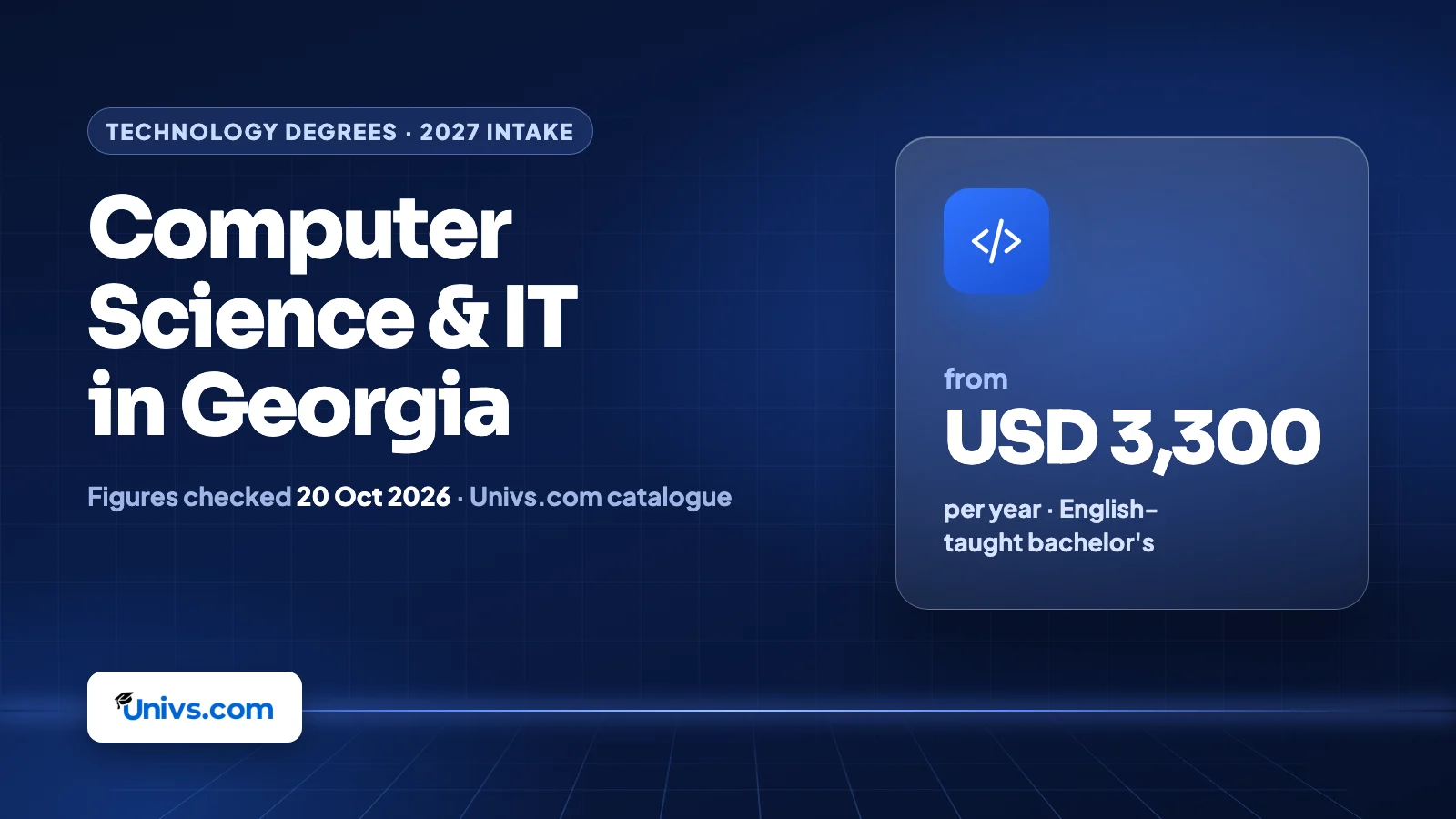
The lowest published English-taught Computer Science tuition in Georgia on Univs.com for the 2027 intake is USD 3,300 a year at Grigol Robakidze University, about USD 9,900 for the three-year degree. Most English-taught Computer Science and IT bachelor's degrees in Georgia cost USD 3,300 to 5,500 a year, and Univs charges students no agency, consultancy or service fee.
Computer Science, IT and Computer Engineering, 2027 intake
| Programme | University | Tuition per year | Duration | Tuition, whole programme* | University application fee | How to apply |
|---|---|---|---|---|---|---|
| Information Technology | Grigol Robakidze University | USD 3,300 | 3 Years | USD 9,900 | from USD 300 | Apply on Univs (official Univs partner) |
| Computer Science with Artificial Intelligence (AI) | Grigol Robakidze University | USD 3,300 | 3 Years | USD 9,900 | from USD 300 | Apply on Univs (official Univs partner) |
| Computer Science | Grigol Robakidze University | USD 3,300 | 3 Years | USD 9,900 | from USD 300 | Apply on Univs (official Univs partner) |
| Computer Science | Alte University | USD 3,500 | 4 Years | USD 14,000 | from USD 250 | Apply on Univs (official Univs partner) |
| Bachelor Educational Program in Information Technology in English | Caucasus International University | USD 3,500 | 4 Years | USD 14,000 | from USD 200 | Listing only (apply to the university directly) |
| Information Technologies (IT) | Georgian National University SEU | USD 3,900 | 4 Years | USD 15,600 | from USD 300 | Apply on Univs (official Univs partner) |
| Computer Science | University of Georgia | USD 4,000 | 3 Years | USD 12,000 | from USD 170 | Apply on Univs (official Univs partner) |
| Computer Science | Ilia State University | USD 4,500 | 4 Years | USD 18,000 | from USD 200 | Apply on Univs (official Univs partner) |
| Information Technology (IT) | University of Georgia | USD 4,500 | 4 Years | USD 18,000 | from USD 170 | Apply on Univs (official Univs partner) |
| Computer Engineering | University of Georgia | USD 4,500 | 3 Years | USD 13,500 | from USD 170 | Apply on Univs (official Univs partner) |
| Informatics | Caucasus University | USD 5,000 | 3 Years | USD 15,000 | from USD 300 | Apply on Univs (supported through a third-party partner) |
| Computer Science | Caucasus University | USD 5,000 | 3 Years | USD 15,000 | from USD 300 | Apply on Univs (supported through a third-party partner) |
| Computer Engineering | Ilia State University | USD 5,000 | 4 Years | USD 20,000 | from USD 200 | Apply on Univs (official Univs partner) |
| Computer Science & Artificial Intelligence (AI) | Caucasus University | USD 5,500 | 3 Years | USD 16,500 | from USD 300 | Apply on Univs (supported through a third-party partner) |
| Computer science | Georgian Technical University | GEL 12,500 | 4 Years | GEL 50,000 | from USD 1,000 | Apply on Univs (official Univs partner) |
Figures come from the Univs catalogue and were checked on 20 October 2026. Tuition and fees are set by each university and can change; the programme page always shows the current figure. *Whole-programme tuition is the yearly fee multiplied by the published duration, at the current rate.
Georgian Technical University publishes its fees in Georgian lari (GEL). Convert at the current rate when you compare.
How we compared
Every figure comes from the programme records that universities publish on Univs.com, the same data that powers the programme pages. We included programmes with a published yearly tuition, sorted them from lowest to highest, and multiplied the yearly fee by the published duration to show tuition for the whole programme at the current rate. Application fees are the lowest amount each university lists; where a university lists more than one application fee, the programme page shows which one applies to you. We did not add living costs, insurance, visa or travel, because those depend on how and where you live. We also did not rank universities on quality: price is only one input, and the right programme is the one you are eligible for, that is recognised where you plan to work, and that you can afford for every year of study.
Computer Science, IT and Computer Engineering: the differences
Computer Science focuses on programming, algorithms, data structures and the theory behind software. Information Technology programmes are more applied, covering networks, systems administration, databases and managing technology in organisations. Computer Engineering adds hardware, electronics and embedded systems. Several universities also run Computer Science with Artificial Intelligence. Read each programme’s structure and learning outcomes on its page before you compare price, because two degrees with similar names can teach quite different things.
Studying technology in Tbilisi
All the universities in the table are in Tbilisi, so living costs are broadly similar and the tuition gap is the main difference. Ask the university about laboratory access, class sizes and how the final-year project is supervised.
Checklist before you apply
- Open the programme page and confirm the tuition, duration, teaching language and the next intake shown there today.
- Read the Requirements section: minimum grades, age limits, language evidence and any nationalities or countries of residence that cannot apply.
- Prepare clear scans of your passport, school-leaving certificate or previous degree with transcripts, and a recent photo.
- Ask the university, through your application, whether its application fee is refundable or deducted from tuition.
- Plan for recognition of your previous education by the Georgian authorities, which is a legal step for international students and takes time.
- Keep every invoice and receipt, and pay only through the invoice in your account or the university’s own official channel.
What you pay, and to whom
Univs charges students no agency, consultancy or service fee, because Univs is paid by the universities, not by students. Any application or registration fee set by the university is shown before you pay. Tuition is paid to the university. If you pay an invoice by card, any card processing fee is also shown before checkout. Living costs, insurance, visa and travel are separate and are not included in the tables above.
Ready to apply? Open the programme page and press Apply Now. You complete one online form, upload your documents and follow every stage in My Univs. Step-by-step guide: How to apply to universities in Georgia for free.
Common questions
What is the cheapest computer science degree in Georgia in English?
On Univs.com, Grigol Robakidze University has the lowest published tuition for English-taught Computer Science for the 2027 intake: USD 3,300 a year for its three-year Computer Science and Computer Science with AI degrees, about USD 9,900 in tuition for the whole programme at the current rate.
Can I study IT in Georgia in English?
Yes. Several universities in Tbilisi teach Computer Science, Information Technology and Computer Engineering in English, with published tuition from USD 3,300 to USD 5,500 a year on Univs.com. Georgian Technical University also teaches Informatics in Russian and publishes its fees in Georgian lari, so convert them before comparing.
Three or four years?
Some universities in Georgia run three-year bachelor’s degrees in computing and others four-year degrees. A four-year degree costs more in total even when the yearly fee is lower, so compare the whole-programme tuition column, and check whether the country where you plan to work or study further expects four years.
Primary sources
- Grigol Robakidze University, official website
- Alte University, official website
- University of Georgia, official website
- Ilia State University, official website
- Caucasus University, official website
- Georgian National University SEU, official website
- Georgian Technical University, official website
- National Center for Educational Quality Enhancement (NCEQE), Georgia
Editorial note
Requirements can change and may differ by institution, programme and applicant. Recheck current university and government guidance before paying or travelling.
For comparisons, we assess the stated student brief, current route availability, discovery breadth, application ownership, progress visibility, support, costs and duplicate-application risk. Univs publishes this page and may have commercial relationships with institutions; those relationships do not determine admission decisions. Read our editorial standards.