
Blockchain – Distributed Information Systems

Program Overview
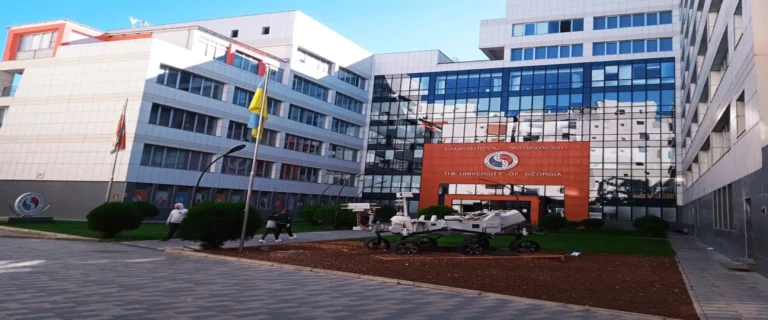
Blockchain – Distributed Information Systems at the University of Georgia is an English-taught Master's programme in two parts ("1+1"): Part I is a one-year, 60 ECTS Master of Information Systems and Part II a one-year, 60 ECTS Master of Research in Information Systems ending with a 30 ECTS Master's project.
Use these primary sources to recheck time-sensitive facts before paying or applying.
Goals, Outcomes & Methods
Develop specialists in distributed-ledger architecture and infrastructure, the law of virtual assets, blockchain business models and real-world asset tokenisation, secure coding and security methods in blockchain systems, with electives in AML/sanctions for virtual assets, crypto regulation and IT management; and — in Part II — in cryptography, smart contracts and research.
Graduates can design and secure distributed-ledger systems; evaluate blockchain business models and tokenisation; apply legal and compliance rules for crypto assets; build smart-contract solutions; and, after Part II, complete an independent research project.
Lectures, seminars, guided discussion, case and problem-based learning, individual and group assignments, presentations, practical or laboratory sessions, independent study, digital learning resources, and project or research supervision.
Program Structure & Plan
2 years, 120 ECTS in two parts. Part I (year 1, 60 ECTS) — core courses: Architecture and Infrastructure of Distributed Ledger Systems, Law of Virtual Assets, Blockchain-Based Business Models and Real-World Asset Tokenization, Secure Coding and Cybersecurity in Blockchain Systems, Security Methods in Blockchain; plus electives. Awards Master of Information Systems. Part II (year 2, 60 ECTS) — Academic Writing and Research and a 30 ECTS Master's project, with electives such as Cryptography and Smart Contract Technologies; plus electives. Awards Master of Research in Information Systems.
Course Syllabus
View the course syllabus in a new Univs tab.
Tuition & Fees
| Fee Type | Year 1 | Year 2 | Total |
|---|---|---|---|
| Academic Fees | |||
|
Tuition Fee
|
4,000 | 4,000 | 8,000 |
|
Application Fee
|
170 | — | 170 |
| Living & Accommodation | |||
|
General Living Expenses (Including Accommodation)
|
3,500 | 3,500 | 7,000 |
|
Accommodation
|
3,500 | 3,500 | 7,000 |
| Other Fees | |||
|
Visa Fee
|
25 | — | 25 |
|
Residence Permit (TRC) Fee
|
100 | — | 100 |
| Grand Total | 11,295 | 11,000 | 22,295 |
No scholarships are currently available for this program.
Who Should Apply
Bachelor's graduates in IT, computer science, finance, law or business interested in blockchain systems, digital assets and fintech.
Admission Requirements
Passport
Passport, Passport-size photo, Academic transcript, Diploma / certificate
Required Documents
Career Prospects
University Accreditation & Recognition
Program Accreditation & Recognition
Program offered within University Of Georgia's authorized higher-education framework. Applicants should verify the current program-level accreditation status and any profession-specific recognition with the university and relevant regulator.
General Information
During the first semester, students deeply familiarize themselves with global transformations and technological trends within the context of which they will operate. During this period, they acquire fundamental knowledge of the principles and operational foundations of decentralized systems, and deepen their understanding of innovative business models, cryptography, and practical programming. In the second semester, students develop theoretical and practical competencies related to the functioning and programming of cryptocurrencies. Simultaneously, they gain knowledge and skills in business process description, modeling, documentation, and redesign. In the third semester, students acquire theoretical knowledge and practical skills in smart contracts, as well as study principles and methods of information technology project management.
At the end of each semester, students create integrated projects based on the theoretical and practical knowledge acquired, facilitating the consolidation of interdisciplinary skills. Based on the experience from these integrated projects, in the fourth semester (after one year of study), the master’s student begins preparing the master’s thesis. During the thesis preparation process, the student receives consultations from the program director and/or co-supervisor, ensuring the successful development of the research component and professional growth. Students also create a prototype of their own startup, blockchain-based system, or service.
Students who require a visa to study at an authorized Georgian institution normally apply for a D3 immigration visa. The correct entry route depends on citizenship and legal residence, so applicants must check Georgia’s eConsul eligibility tool and the responsible embassy before applying. Students staying long term may also need a study residence permit after arrival.
Signed D3 visa application and e-application report
Valid passport
Invitation Letter
Admission letter from an authorized Georgian university
Ministry Order and Rector Order
Proof that the university and programme are authorized or accredited where requested
Proof of accommodation in Georgia
Travel and Health Insurance
Biometric photograph
Visa fee payment receipt
For applicants under 18: parental passport copies and consent letter
10-30 days
20-100
University of Georgia Student Reviews
A preview of verified student reviews and source-attributed reviews about University of Georgia and its programs.


 Google Maps
Google Maps
Google Maps
Google Maps
Google Maps
Most of their doctors are fresh graduates, young, and lack experience. And they don't have good dealings with the students. And even when we go to complain to the administration, the administration doesn't do anything for the doctor, and the doctor goes on more and more and becomes stronger against the students more and more, and even in some of them they have racism, they fail students for no reason. And more than once we complain about them, and the administration does nothing, the administration, on the contrary, strengthens them against us, and the administration doesn't listen to us or listen to our voice. The worst university you can see in the world, and other than that, they fail students for no reason, or they are setting up ambushes for students to fail them in any way to increase their university's economy. Because the system of their university is a commercial system, the most important thing for them is money, a hungry people or a hungry university in general, they want money only, but they are not coming to solve any administrative problems, nor do they care, I mean even the student The one who doesn't think about transfer thinks about transfer, why? Because in all cases, you will fail more than once with them when no one listens to you. So it is better for the person to go to a university that treats them better and their doctors are better than these doctors. At least the administration cooperates with the students.
No reviews in this five-review preview match that rating.
✎ Suggest a Program Update
Add missing content or correct existing information. Every suggestion is verified before publication.
 Georgia













 Kyrgyzstan









 Qatar
Qatar